Theme 2: Diversity
grade 11 chemistry · theme 2
2.1.1 Characteristics of Reversible Reactions
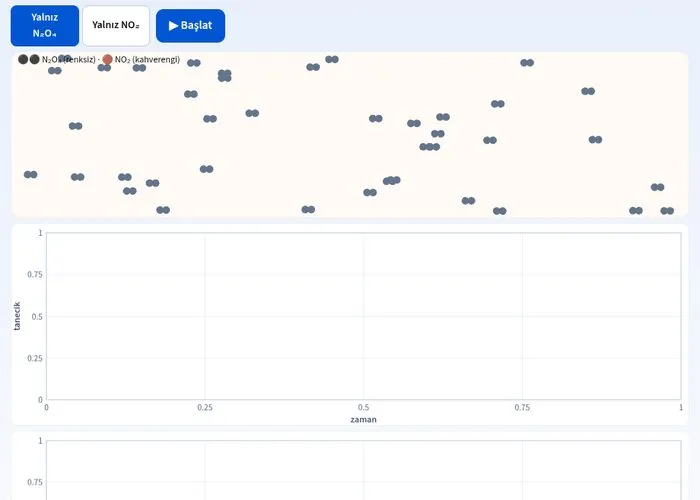
Reversible reactions: observe the N₂O₄ ⇌ 2NO₂ reaction at the particle level in a closed container; see on the graph how forward and reverse reaction rates become equal over time and concentrations stabilize; dynamic equilibrium, closed and open system
Open Simulation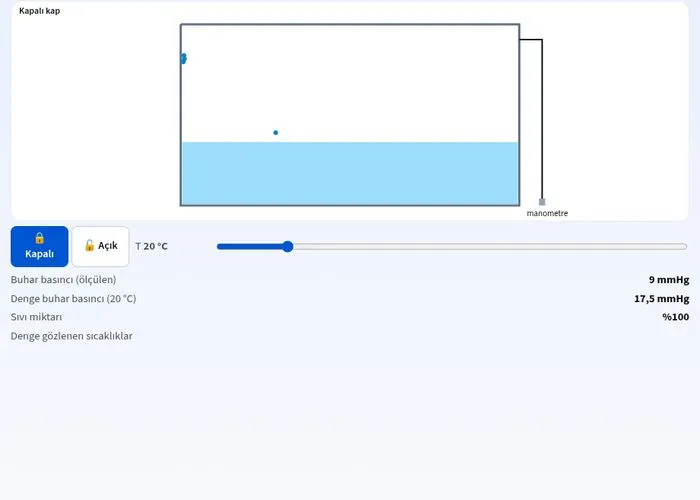
2.1.2 Equilibrium in Physical and Chemical Changes
Physical and chemical equilibrium: observe the evaporation-condensation equilibrium of water and the change in vapor pressure with temperature in a closed container, and the dissolution-precipitation equilibrium in a saturated salt solution; compare the inability to establish equilibrium in an open container
Open Simulation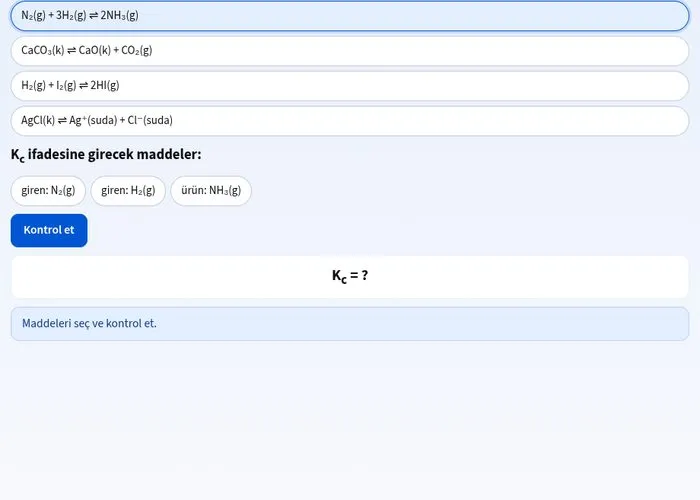
2.1.3 Writing the Equilibrium Constant Expression
Equilibrium constant expression: set up the Kc expression for homogeneous and heterogeneous equilibria (solids and pure liquids are omitted); calculate Kc from equilibrium concentrations; Kp = Kc(RT)^Δn conversion; effect of reversing the equation and multiplying by coefficients on K
Open Simulation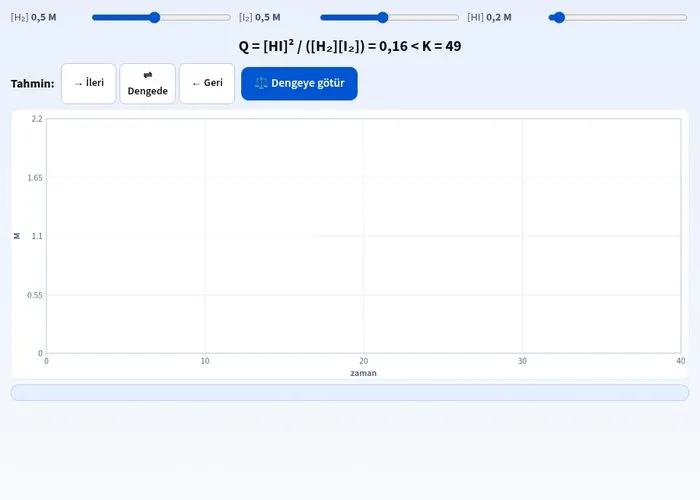
2.1.4 Reaction Rate
Reaction quotient Q: adjust concentrations in the H₂ + I₂ ⇌ 2HI mixture, calculate Q and compare it with K to predict the direction in which the reaction will proceed; bring the system to equilibrium and verify the result
Open Simulation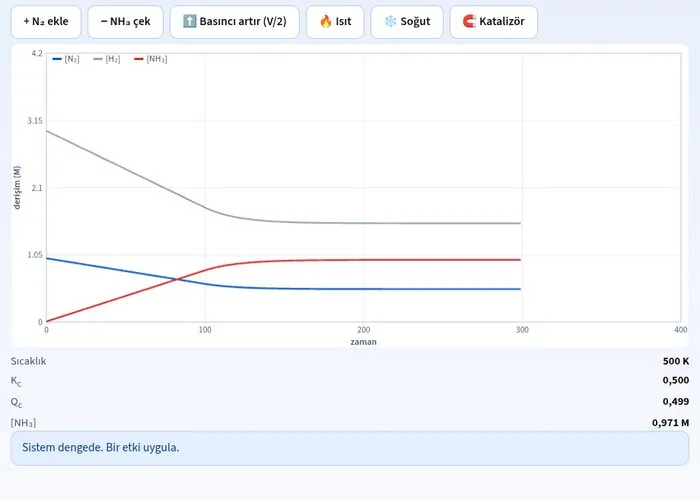
2.1.5 Factors Affecting Equilibrium
Le Chatelier's principle: add/remove substance, change temperature and pressure in the N₂ + 3H₂ ⇌ 2NH₃ (exothermic) equilibrium; observe the shift of equilibrium and the new equilibrium on the concentration-time graph; select optimal conditions for Haber-Bosch
Open Simulation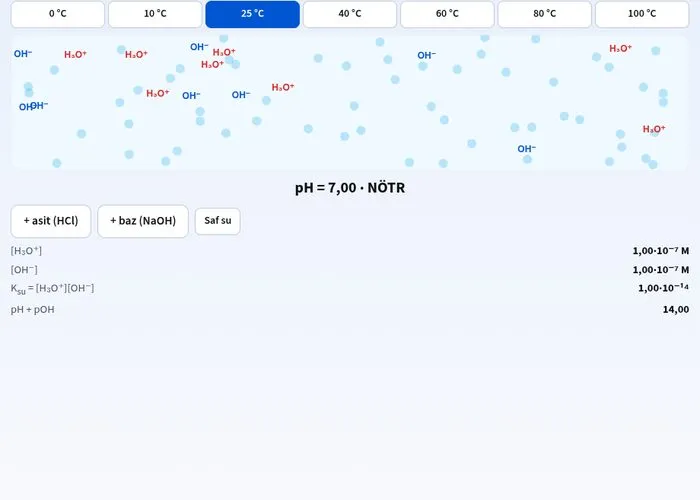
2.2.1 Autoionization of Pure Water
Autoionization of water: H₂O + H₂O ⇌ H₃O⁺ + OH⁻; examine the change in Kw and the pH of pure water by changing temperature; demonstrate that the product [H₃O⁺][OH⁻] remains constant when acids and bases are added
Open Simulation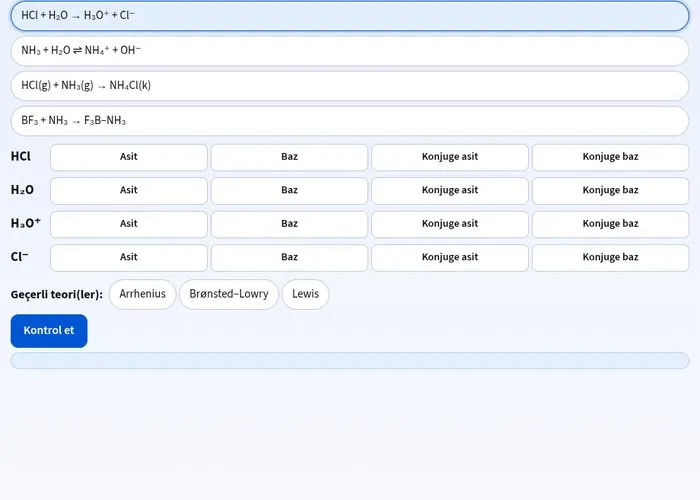
2.2.2 Comparison of Acid-Base Theories
Acid-base theories: compare Arrhenius, Brønsted-Lowry, and Lewis definitions on reactions; mark proton-donor/acceptor and electron pair-donor/acceptor species; match conjugate acid-base pairs
Open Simulation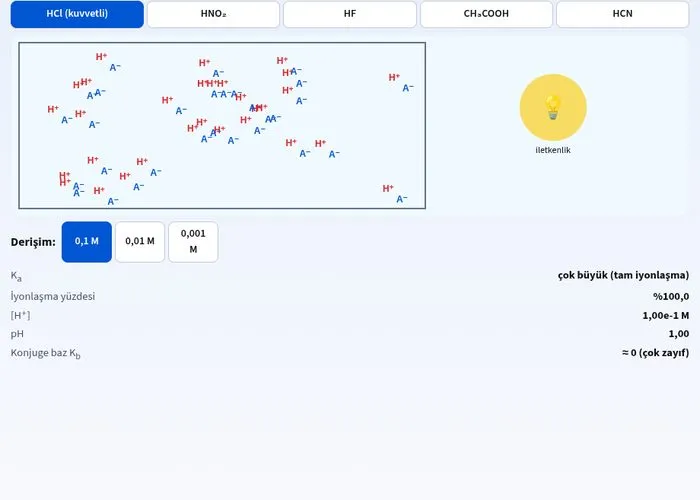
2.2.3 Strength of Acids and Bases
Acid and base strength: compare strong HCl and weak CH₃COOH solutions at the particle level, with a conductivity lamp, and by pH; calculate percentage ionization from the Ka value; conjugate base strength
Open Simulation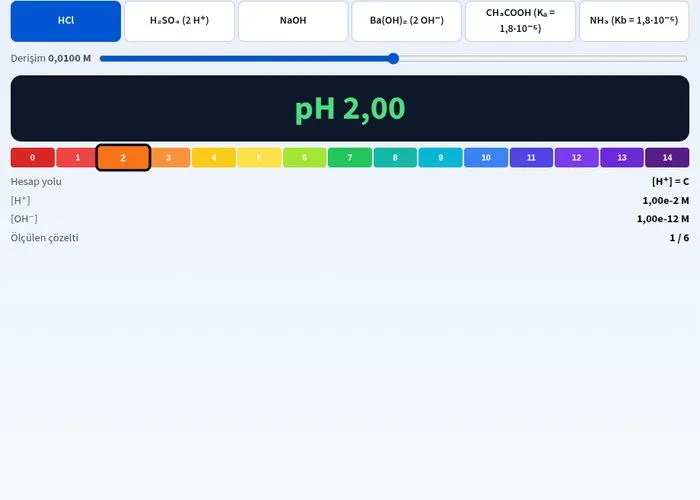
2.2.4 pH Calculations in Acid and Base Solutions
pH calculation workshop: vary concentration in strong acid, strong base, weak acid, and weak base solutions; observe the pH meter and universal indicator color; [H⁺] = √(Ka·C) approximation and the effect of dilution on pH
Open Simulation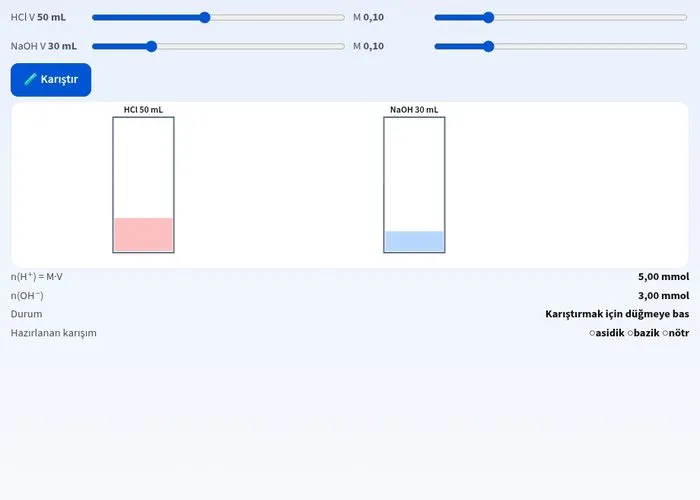
2.2.5 Neutralization Reactions of Strong Acids and Bases
Neutralization: adjust and mix volumes and concentrations of HCl and NaOH solutions; calculate excess ion, formed salt, and mixture pH; measure temperature increase with heat of neutralization
Open Simulation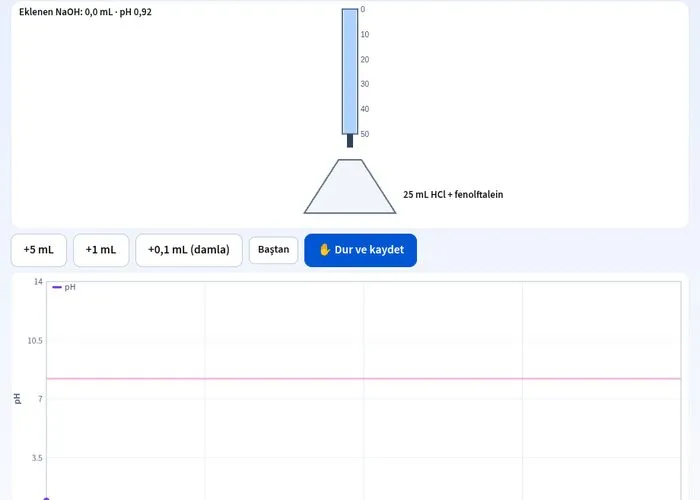
2.2.6 Strong Acid-Strong Base Titrations
Titration: titrate an HCl solution of unknown concentration by dropwise addition of NaOH from a buret; capture the equivalence point using phenolphthalein color and the pH curve; calculate unknown concentration using M_a·V_a = M_b·V_b
Open Simulation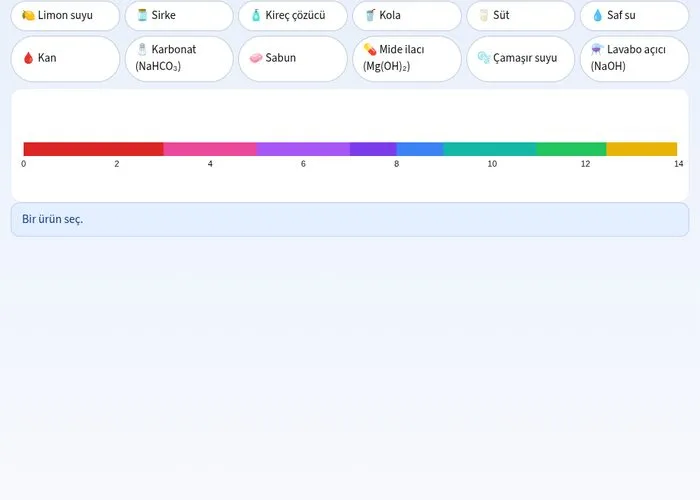
2.2.7 Selection of Acidic and Basic Products
Household products pH scale: test products such as lemon juice, vinegar, soap, bleach, descaler, and antacid with red cabbage indicator and place them on the pH scale; select the acidic or basic product appropriate for problem situations; safe usage
Open Simulation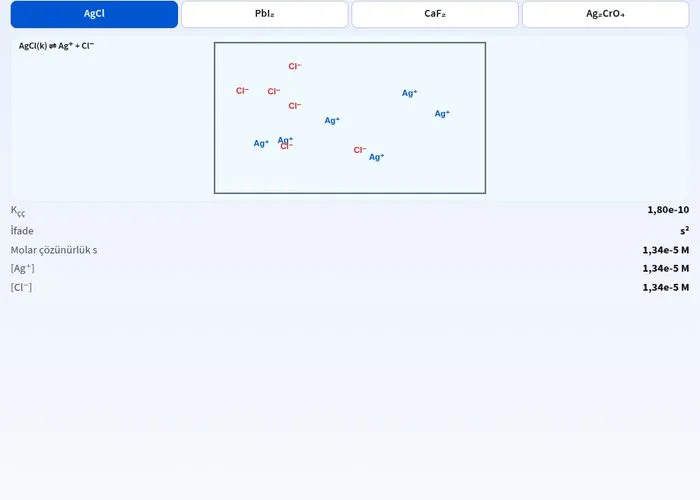
2.3.1 Molar Solubilities of Sparingly Soluble Salts in Water
Solubility product Ksp: calculate molar solubility of AgCl, PbI₂, CaF₂, and Ag₂CrO₄ salts from s to Ksp and from Ksp to s; predict whether precipitation will occur by comparing Q and Ksp when two solutions are mixed
Open Simulation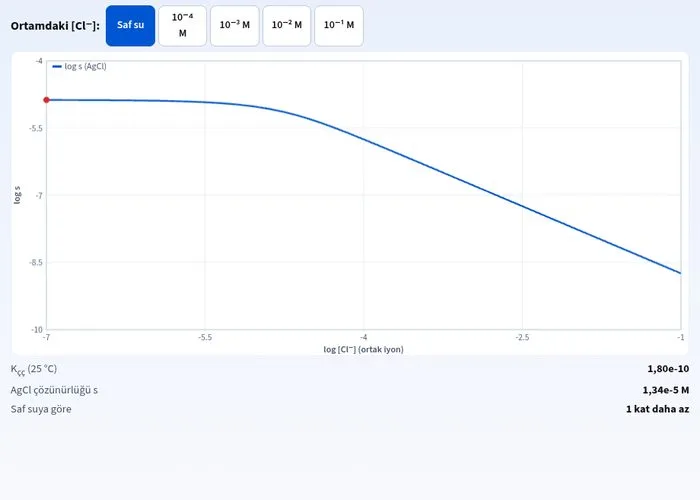
2.3.2 Factors Affecting the Solubility of Sparingly Soluble Salts
Factors affecting solubility: examine on a graph the common-ion effect by adding NaCl to an AgCl solution, the effect of temperature on solubility, and how pH alters the solubility of basic salts such as Mg(OH)₂
Open Simulation