pH calculation workshop: vary concentration in strong acid, strong base, weak acid, and weak base solutions; observe the pH meter and universal indicator color; [H⁺] = √(Ka·C) approximation and the effect of dilution on pH
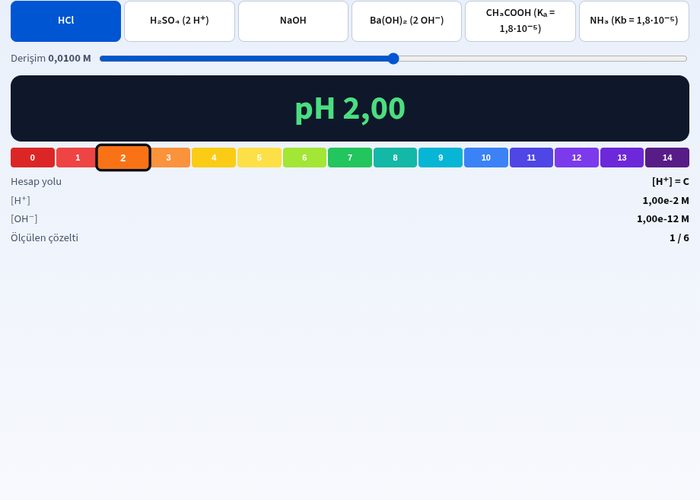
Explore the acidity degrees of strong and weak solutions with the pH Calculations in Acid and Base Solutions simulation. In this interactive workshop, you can change the solution concentration to monitor changes on the pH meter and observe universal indicator colors. It helps you reinforce theoretical knowledge from chemistry lessons with practice.
What can you do in this simulation?
You can change concentration values of different solutions and observe the results.
You can measure the acidity or basicity degrees of solutions using a pH meter.
You can verify the pH calculations of strong and weak acid-base solutions.
You can distinguish the solution type by following universal indicator color changes.
Basic concepts and formulas
When calculating the pH of acid and base solutions, the hydrogen ion concentration ([H⁺]) is used as the basis. In strong acids, the [H⁺] concentration is directly equal to the molarity of the acid and is calculated using the formula pH = -log[H⁺]. In weak acids, the approximation [H⁺] = √(Ka·C) is used, where Ka represents the acid dissociation constant and C represents the concentration of the solution. Similarly, the sum of pOH and pH is always equal to 14 at 25 °C.
How to use?
Select the solution you want to examine from the experiment panel.
Adjust the concentration parameters of the solution according to your preference.
Make your prediction and save your answer to the system.
Check your calculation by examining the pH meter and indicator colors.
Evaluate the results and review the steps where you fell short.
Frequently asked questions
Why is Ka used when calculating pH in weak acids?
Since weak acids partially ionize in water, the [H⁺] concentration is not equal to the initial concentration; therefore, calculations are made with the help of the equilibrium constant Ka.
What is the primary relationship between pH and pOH?
At a temperature of 25 °C, the sum of the pH and pOH values of a solution is always equal to 14.
How does the dilution process affect the pH value of the solution?
As acid solutions are diluted, the [H⁺] concentration decreases and the pH value approaches 7.
 Interactive experiment