Household products pH scale: test products such as lemon juice, vinegar, soap, bleach, descaler, and antacid with red cabbage indicator and place them on the pH scale; select the acidic or basic product appropriate for problem situations; safe usage
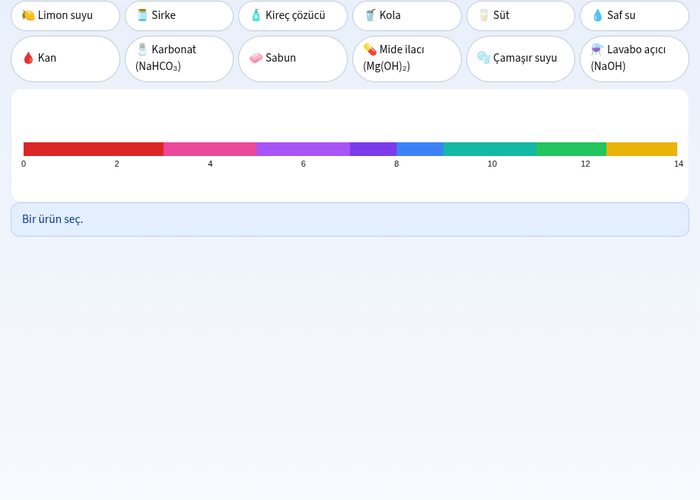
Discover the acidic and basic properties of substances you frequently encounter in daily life with the household products pH scale simulation. In this interactive experiment, you will test 12 different products such as lemon juice, milk, soap, and bleach using red cabbage indicator, place the substances on the pH scale, and choose the appropriate acidic or basic product for problem scenarios. You will reinforce the acid-base concepts you learned in chemistry class through practice and learn ways to be a conscious consumer in daily life.
What can you do in this simulation?
You can test 12 different household products with the red cabbage juice indicator.
You can move the products to the correct boxes and their positions on the pH scale using drag-and-drop.
You can examine reactions such as acids dissolving carbonated limescale or weak bases neutralizing stomach acid.
You can solve questions by choosing the correct acidic or basic product appropriate for the problem scenarios.
You can reset the simulation and renew your choices by using the restart button.
Basic concepts and formulas
Acids are substances that donate hydrogen ions (H⁺) to water, while bases are substances that donate hydroxide ions (OH⁻) or accept protons. The pH scale ranges between 0 and 14; 0-7 indicates acidic character, 7 neutral, and 7-14 basic character. For example, in the descaling reaction, the acid dissolves carbonated limescale as follows: CaCO₃ + 2H⁺ → Ca²⁺ + H₂O + CO₂. In neutralization reactions, an acid and a base combine to form salt and water.
How to use?
Open the experiment panel and examine the 12 products to be tested.
Place a card or product into the relevant category box by tapping or dragging and dropping.
Determine whether the product is acidic or basic by observing the cabbage juice color change.
Read the problem scenarios, select the correct product, and click the check button.
Repeat the experiment by reviewing your missing or incorrect answers.
Frequently asked questions
Why is red cabbage juice used as an indicator?
Red cabbage turns red/pink in acidic environments, purple in neutral environments, and green/yellow in basic environments due to the anthocyanin pigment it contains. These color changes allow you to easily understand the pH level of substances.
Why should we pay attention to the pH value when choosing household products?
When using cleaning products or foods, pH values are of critical importance for health and safety. For example, while excessively acidic descalers can damage surfaces, basic substances can neutralize acid poisonings or heartburn.
Which substances are tested in the simulation?
In this experiment, 12 different everyday household products such as lemon juice, milk, baking soda, bleach, descaler, and antacid are tested.
 Interactive experiment