Physical and chemical equilibrium: observe the evaporation-condensation equilibrium of water and the change in vapor pressure with temperature in a closed container, and the dissolution-precipitation equilibrium in a saturated salt solution; compare the inability to establish equilibrium in an open container
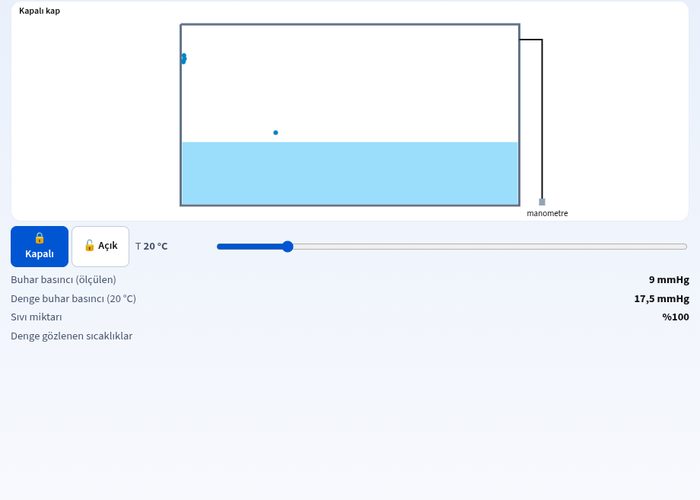
Discover dynamic processes and equilibrium conditions in closed vessels with the equilibrium in physical and chemical changes simulation. This interactive chemistry experiment allows you to observe the evaporation-condensation equilibrium of water, dissolution-precipitation equilibrium in saturated solutions, and the differences between open and closed vessels. Prepared in accordance with the 11th grade chemistry curriculum, this content helps you reinforce the concept of chemical equilibrium and easily learn the effects of temperature and pressure changes on the system.
What can you do in this simulation?
You can compare closed and open vessel systems to examine how vapor escapes and why equilibrium cannot be established in an open vessel.
You can follow the physical equilibrium state step by step by observing the evaporation and condensation rates of water.
You can test the dynamic structure of the system by creating a saturated salt solution and establishing the dissolution-precipitation equilibrium.
You can monitor the effect of temperature changes on vapor pressure with values in mmHg.
By answering the questions with the help of the guide, you can test your predictions against the experiment results and review topics you are missing.
Basic concepts and formulas
Chemical and physical equilibrium occurs in a closed system when the rate in the forward direction (R_forward) is equal to the rate in the reverse direction (R_reverse). For example, while the transformation H2O(l) <-> H2O(s) occurs in liquid-vapor equilibrium, the solid substance and dissolved ions are in equilibrium in saturated solutions: X(s) <-> X(aq). This simulation emphasizes that the system is in a dynamic state, meaning microscopic events continue even though macroscopic (observable) properties remain constant.
How to use?
Go to the experiment panel, read the guide's instructions, and examine the initial state.
Place your predictions by tapping the relevant boxes or columns using cards or options.
Observe evaporation and condensation processes by switching between closed container and open container modes.
Follow the steps to create a saturated solution, and control the changes in temperature and pressure values.
Check the correct answers, and reinforce your knowledge by repeating the steps where you fell short.
Frequently asked questions
Why cannot physical equilibrium be established in open vessels?
Because in open vessels, evaporating substances (such as water vapor) leave the system and cannot return to condense, which prevents the reverse process from occurring, thus preventing the formation of dynamic equilibrium.
What happens at equilibrium in a saturated solution?
The rate of dissolution becomes equal to the rate of precipitation. Although the substance precipitates to the bottom in solid form, dissolution continues, so no macroscopic change is observed, but the system is dynamic.
How does vapor pressure change if temperature increases?
As temperature increases, the kinetic energy of the particles increases, which raises the vapor pressure by increasing the number of molecules transitioning from the liquid phase to the gas phase per unit time.
 Interactive experiment