Titration: titrate an HCl solution of unknown concentration by dropwise addition of NaOH from a buret; capture the equivalence point using phenolphthalein color and the pH curve; calculate unknown concentration using M_a·V_a = M_b·V_b
Learn to titrate a hydrochloric acid solution of unknown concentration with sodium hydroxide using the Strong Acid-Strong Base Titrations simulation. Interactively observe the effect of the base you drop from the buret, the equivalence point where the phenolphthalein indicator changes color, and the sudden jumps in the pH curve. It is a great resource to reinforce chemistry laboratory experiments.
What can you do in this simulation?
You can controllably drip NaOH from the buret and track the added amount of base in milliliters.
You can observe the color changes in the Erlenmeyer flask containing 25 mL HCl and phenolphthalein.
You can catch the equivalence point jumps in the pH curve and the moment of acid-base neutralization.
You can test your theoretical knowledge with practice by answering the questions with the help of the guide.
You can perform unknown concentration calculations using the equation Ma·Va = Mb·Vb.
Basic concepts and formulas
When a strong acid (HCl) and a strong base (NaOH) are completely neutralized, the medium becomes neutral, and the pH value shows 7 at the equivalence point. The basic formula used in titration calculations is: Ma·Va = Mb·Vb (Concentration of acid times volume of acid equals concentration of base times volume of base). Phenolphthalein, on the other hand, is an indicator that turns pink in a basic medium and allows us to determine the equivalence point.
How to use?
Open the experiment panel and examine the initial HCl solution and phenolphthalein indicator.
Start adding NaOH from the buret in a controlled manner and track the amount of base added.
Observe the change in the pH curve and the equivalence point where the phenolphthalein turns pink.
Test your predictions and check your calculations by answering the questions in the guide.
Frequently asked questions
What is the equivalence point?
It is the moment during titration when the acid and base are completely equivalent, the indicator changes color, and the pH curve shows a sharp vertical jump.
Why is phenolphthalein used?
It is an indicator that allows us to understand whether a medium is acidic or basic through a color change; in strong acid-strong base titrations, it marks the equivalence point with a pink color.
How is the unknown concentration calculated?
Using the formula Ma·Va = Mb·Vb, the initial concentration of the acid is calculated with the help of the concentration and volume of the consumed base.
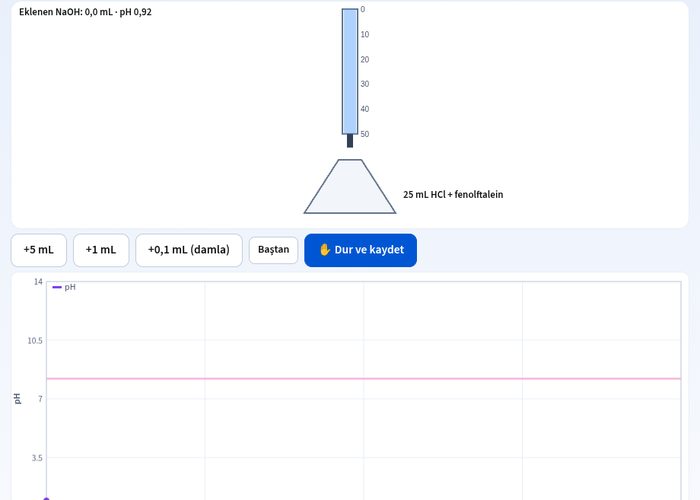 Interactive experiment