Acid-base theories: compare Arrhenius, Brønsted-Lowry, and Lewis definitions on reactions; mark proton-donor/acceptor and electron pair-donor/acceptor species; match conjugate acid-base pairs
With the Comparison of Acid-Base Theories simulation, you can examine Arrhenius, Brønsted-Lowry, and Lewis acid-base definitions in depth over chemical reactions. In this interactive experiment, you can easily learn to distinguish proton-donating and accepting species, match conjugate acid-base pairs, and observe electron-pair transfer. It is a great resource to reinforce theoretical knowledge in chemistry lessons through practice.
What can you do in this simulation?
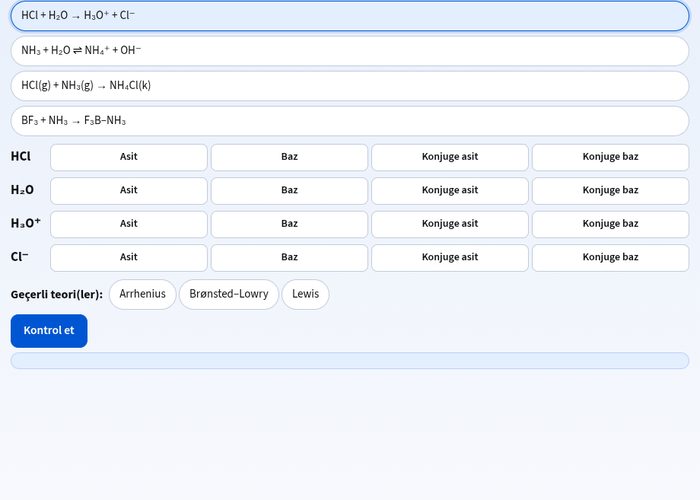
You can compare acid-base theories by solving 4 different reactions step by step.
You can place the cards into the correct boxes and columns by dragging and dropping or by touching them.
You can correctly match conjugate acid and conjugate base pairs.
You can examine proton-donating species in transformations such as HSO4⁻ -> SO4²⁻ + H⁺.
Thanks to instant feedback, you can immediately notice your mistakes and learn the correct answers.
Basic concepts and formulas
In chemistry, acids and bases are defined in various ways by different scientists. According to the Brønsted-Lowry theory, an acid is a proton (H⁺) donor, and a base is a proton acceptor. When an acid donates a proton, its conjugate base remains: HA + H₂O ⇌ H₃O⁺ + A⁻. Lewis theory, on the other hand, focuses on electron-pair acceptance and donation; a Lewis acid is an electron-pair acceptor, and a Lewis base is an electron-pair donor.
How to use?
Open the experiment panel and examine the first reaction and instructions presented to you.
Tap or drag and drop the cards appearing on the screen to move them into the relevant box or column.
After filling in all the blanks, test your answer by clicking the "Check" button.
Examine your correct or incorrect feedback, and repeat the experiment using the "Restart" button if necessary.
Frequently asked questions
What is a conjugate acid-base pair?
Two substances that differ from each other by only a single proton (H⁺) are called a conjugate acid-base pair. When an acid donates a proton, it forms its conjugate base.
How does Lewis theory differ from the others?
While Arrhenius and Brønsted-Lowry theories focus on protons and hydroxide ions, Lewis theory is based on electron-pair transfer and is more comprehensive.
How many reactions do I need to solve in the simulation?
Throughout the simulation, you will have the opportunity to practice acid-base theories by solving a total of 4 different reactions.
 Interactive experiment