Reversible reactions: observe the N₂O₄ ⇌ 2NO₂ reaction at the particle level in a closed container; see on the graph how forward and reverse reaction rates become equal over time and concentrations stabilize; dynamic equilibrium, closed and open system
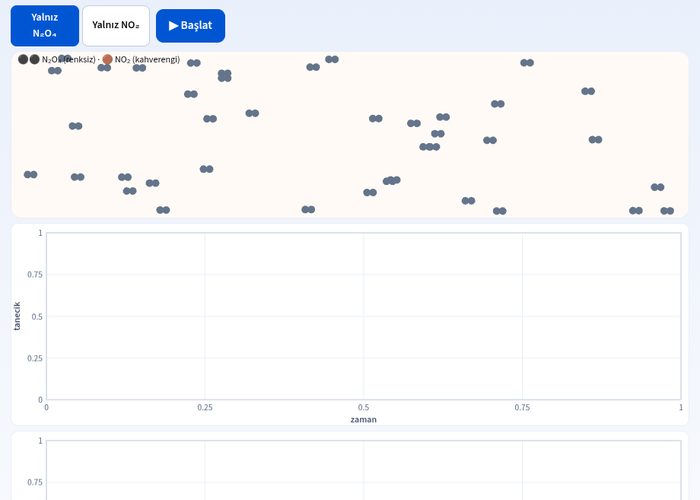
To understand the topic of equilibrium in chemistry lessons, it is very important to examine the characteristics of reversible reactions. With this interactive reversible reactions simulation, you can observe the transformation between N2O4 and NO2 in a closed container at the particle level, and discover how forward and reverse reaction rates become equal over time.
What can you do in this simulation?
You can observe the interaction of N2O4 (colorless) and NO2 (brown) particles in a closed system.
You can track the change of forward and reverse reaction rates over time on the graph.
You can examine the effect of changes at the particle level on macroscopic concentrations.
You can test your chemical equilibrium knowledge with guided questions and test steps.
You can test different initial conditions by restarting the experiment.
Basic concepts and formulas
While many chemical reactions proceed in a single direction, some can proceed in both directions. Such reactions are called reversible (bidirectional) reactions. For example, in the system N2O4 ⇌ 2NO₂, when the forward reaction rate (R_forward) equals the reverse reaction rate (R_reverse), dynamic equilibrium is established. At equilibrium, macroscopic properties (color, pressure, concentration) remain constant while processes continue at the microscopic level.
How to use?
Open the simulation screen and examine the initial state of N2O4 and NO2 particles.
Follow the steps using the Forward button and answer the guided questions.
Observe how the forward and reverse reaction rates reach equilibrium over time from the graphics panel.
Reinforce what you have learned with card matching and prediction activities.
Frequently asked questions
What is a reversible reaction?
If the products of a reaction proceeding in the forward direction can recombine to form the reactants, these reactions are called reversible and are indicated by a double arrow (⇌).
What happens at the moment of chemical equilibrium?
The forward reaction rate and the reverse reaction rate become equal to each other. The concentrations of reactants and products remain constant, but the process does not stop at the molecular level, it is dynamic.
Why is a closed container required?
A closed system is necessary so that substances in the gas phase do not escape and the system can reach equilibrium by cutting off matter exchange.
 Interactive experiment