Equilibrium constant expression: set up the Kc expression for homogeneous and heterogeneous equilibria (solids and pure liquids are omitted); calculate Kc from equilibrium concentrations; Kp = Kc(RT)^Δn conversion; effect of reversing the equation and multiplying by coefficients on K
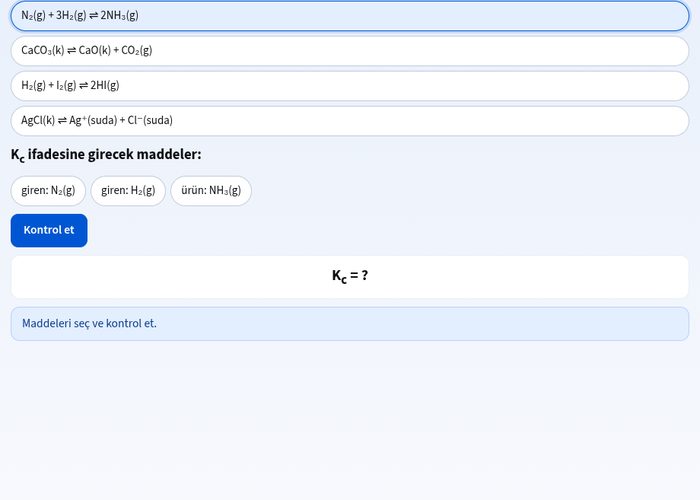
You can easily write equilibrium relations in homogeneous and heterogeneous systems with the equilibrium constant expression simulation prepared to reinforce the subject of chemical equilibrium in chemistry class. You can practice Kc calculations by seeing that solids and pure liquids are not written in the equilibrium expression through reactions such as CaCO3(s) ⇌ CaO(s) + CO2(g). This interactive tool is ideal for reinforcing the equilibrium constant rules and terms in the 11nd grade chemistry curriculum.
What can you do in this simulation?
You can formulate the Kc equilibrium constant expression for homogeneous and heterogeneous equilibria.
You can test that solid and pure liquid substances are not included in the equilibrium expression.
You can place the cards into the correct boxes by dragging and dropping or tapping in the given steps.
You can check your correct answers accompanied by the guide and make use of hints where you get stuck.
You can reset the experiment by pressing the Restart button and review your calculations again.
Basic concepts and formulas
Chemical equilibrium is established at the moment when the rate of the forward reaction equals the rate of the reverse reaction. The equilibrium constant (Kc) is found by dividing the concentrations of the products by the concentrations of the reactants; however, pure solids (s) and pure liquids (l) are not written in this expression, only gases (g) and aqueous solutions (aq) are taken into account. For a general reaction, it is expressed as Kc = ([C]^c · [D]^d) / ([A]^a · [B]^b).
How to use?
Start by reading the guide instructions that appear on the experiment screen.
Examine the cards or equilibrium expressions, then drag and drop or tap into the corresponding box.
After filling in all the blanks, test your answers by pressing the "Check" button.
Review the feedback; if correct, move on to the next step, if incorrect, try again using the hints.
Frequently asked questions
Why are solids and pure liquids not written in the equilibrium expression?
Since the concentrations of pure solids and liquids remain constant at a constant temperature, they are not included in the Kc equilibrium constant expression; only gases and dissolved species are effective.
What is heterogeneous equilibrium?
It is the type of equilibrium where the substances in the system exist in at least two different physical states. For example, reactions where solid, liquid, and gas phases coexist form a heterogeneous equilibrium.
Does the Kc value have a unit?
The unit of Kc is calculated separately for each reaction depending on the coefficients of the gases involved in the reaction and the powers of the concentrations, and it can vary.
 Interactive experiment