Solubility product Ksp: calculate molar solubility of AgCl, PbI₂, CaF₂, and Ag₂CrO₄ salts from s to Ksp and from Ksp to s; predict whether precipitation will occur by comparing Q and Ksp when two solutions are mixed
Explore equilibrium calculations in chemistry lessons interactively with the molar solubilities of sparingly soluble salts simulation. In this experiment, you will learn conversions between molar solubility and Ksp by examining solubility product (Ksp) values of salts such as AgCl, PbI₂, CaF₂, and Ag₂CrO₄. You will also mix solutions to compare Q and Ksp and predict whether precipitation will be observed.
What can you do in this simulation?
You can examine 4 different salts (AgCl, PbI₂, CaF₂, and Ag₂CrO₄) in detail.
You can perform transition calculations from s value to Ksp or from Ksp to s value.
You can compare Q and Ksp values by mixing two different solutions.
You can predict whether there will be precipitation in the solution and check the results.
You can solve chemistry problems by progressing step by step with the guide.
Basic concepts and formulas
Sparingly soluble solids form a dynamic equilibrium in water. For example, the equilibrium equation for AgCl salt is written as AgCl(s) ⇌ Ag⁺(aq) + Cl⁻(aq). The solubility product constant Ksp is found by multiplying the concentrations of the ions: Ksp = [Ag⁺]·[Cl⁻]. If we call the molar solubility s, the relation Ksp = s² is obtained. According to the ion coefficients in the salt's formula, this relation takes the form Ksp = 4s³ for PbI₂. When two solutions are mixed, the Q (reaction quotient or ion product) value calculated with the instant concentrations of the ions is compared with Ksp: precipitation occurs if Q > Ksp, and the solution is unsaturated if Q < Ksp.
How to use?
Go to the experiment panel and select the salt to be examined.
Perform the necessary calculations using the given s or Ksp values.
Save your prediction and check the correct answer.
Move on to the two-solution mixing scenario and make a Q and Ksp comparison.
Frequently asked questions
How is there a relationship between molar solubility s and Ksp?
While molar solubility s represents the number of moles of solute in one liter, Ksp is the product of the equilibrium concentrations of these ions. Depending on the coefficients, the Ksp expression turns into an algebraic equation depending on s.
What does the comparison of Q and Ksp mean?
Q is the product of ion concentrations at any given moment; Ksp is the equilibrium constant in a saturated solution. When Q > Ksp, precipitation occurs because the system contains excess substance.
Why are only sparingly soluble salts studied?
Because in completely soluble salts, ionization is unidirectional and occurs at 100%, so an equilibrium constant cannot be defined. Sparingly soluble salts, on the other hand, establish a dynamic equilibrium and are therefore suitable for Ksp calculations.
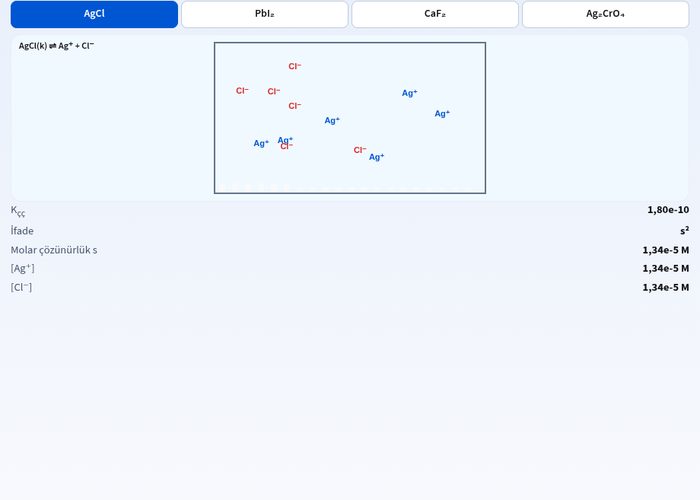 Interactive experiment