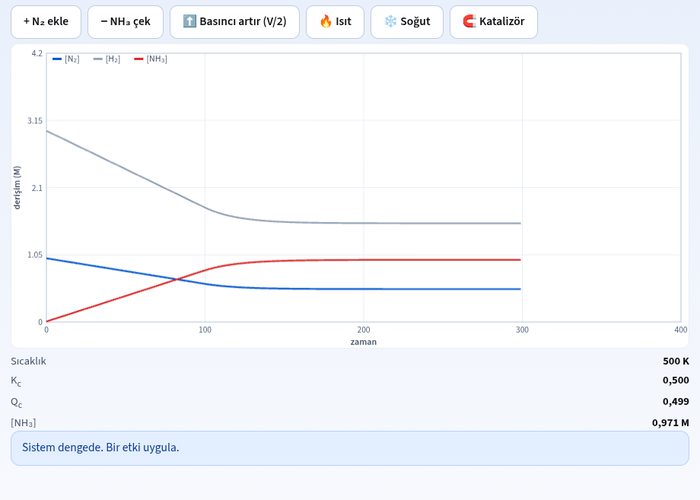
Le Chatelier's principle: add/remove substance, change temperature and pressure in the N₂ + 3H₂ ⇌ 2NH₃ (exothermic) equilibrium; observe the shift of equilibrium and the new equilibrium on the concentration-time graph; select optimal conditions for Haber-Bosch
Discover how equilibrium changes under external influences in chemical reactions with the Le Chatelier's Principle simulation. Thanks to this interactive experiment, you can observe the effect of concentration, temperature, and pressure changes on equilibrium in the exothermic system N2 + 3H2 ⇌ 2NH3, and learn the optimal conditions for the Haber-Bosch process.
What can you do in this simulation?
You can apply 6 different equilibrium effects step by step.
You can examine changes in the concentration-time graph by adding and removing substances.
You can observe the system reaching a new equilibrium by making temperature and pressure adjustments.
You can test the high pressure and temperature equilibrium for the Haber-Bosch process.
You can answer questions with the guidance of the mentor and test your predictions with the experiment.
Basic concepts and formulas
When an external disturbance is applied to a system in chemical equilibrium, the system responds in a direction that reduces this disturbance. This phenomenon is called Le Chatelier's Principle. In exothermic systems, an increase in temperature shifts the equilibrium in favor of the reactants, while an increase in pressure drives the system towards the direction with fewer moles of gas. The equilibrium constant Kc changes only with temperature.
How to use?
Open the experiment panel and read the guide instructions.
Perform substance addition or removal operations.
Observe the system's response by changing temperature and pressure parameters.
Record your predictions by checking the concentration and graph data.
Complete the experiment by answering the questions and reviewing the results.
Frequently asked questions
What is Le Chatelier's principle?
It is the shift of a system in equilibrium to minimize external factors acting upon it.
How does an increase in temperature affect exothermic equilibria?
In exothermic reactions, heat is on the products side; if temperature increases, the equilibrium shifts towards the reactants and the product concentration decreases.
Why is high pressure chosen in the Haber-Bosch process?
Since the number of moles of reactants is greater than that of products in the reaction, high pressure shifts the equilibrium in favor of the products, namely ammonia formation.
 Interactive experiment