Graham's law of diffusion: send NH₃ and HCl gases from both ends of a glass tube, find where the white NH₄Cl ring forms; speed ∝ 1/√M; effusion race with different gas pairs
Explore how gases spread depending on their molecular masses with the Graham's law of diffusion and effusion simulation. In this interactive experiment, by sending gases such as ammonia and hydrogen chloride from the ends of a glass tube, you will find the location where the white ammonium chloride ring forms and compare the diffusion rates of the gases. It is a great interactive tool to reinforce gas laws in chemistry class.
What can you do in this simulation?
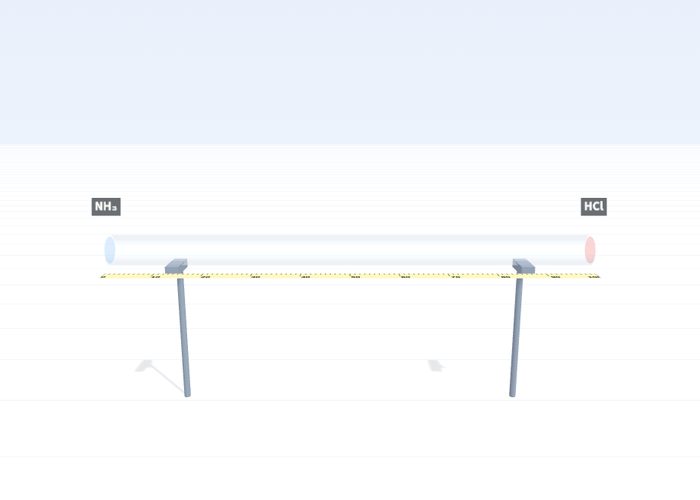
You can observe the diffusion race by sending NH3 and HCl gases from both ends of the glass tube.
You can find out experimentally where the white NH4Cl ring is formed precisely.
You can test the relationship between molar mass and diffusion rate by choosing different gas pairs.
You can verify your theoretical knowledge with practice by making predictions and checking the results.
You can follow the experiment step by step using the forward and reset buttons.
Basic concepts and formulas
According to Graham's law of diffusion, the diffusion or effusion rate of a gas is inversely proportional to the square root of its molecular mass. In other words, gases with smaller molecular weights spread faster. The formula is as follows: V1 / V2 = square root of (M2 / M1). Here, V represents the velocities and M represents the molar masses.
How to use?
Go to the experiment panel and select the gas pairs.
Follow the necessary instructions to send the gases from the ends of the tube.
Save your prediction and observe the location where the white NH4Cl ring is formed.
Check the results and repeat the experiment with different gas pairs.
Frequently asked questions
What is Graham's law of diffusion?
Graham's law is a fundamental chemistry law stating that the diffusion rates of gases are inversely proportional to the square root of their molar masses.
Why does the NH3 ring form closer to HCl?
Since the molar mass of ammonia (NH3) gas is smaller than that of hydrogen chloride (HCl) gas, NH3 diffuses faster and the meeting point occurs closer to the HCl end.
What is the difference between effusion and diffusion?
While diffusion is the mixing of gases into one another, effusion is the escape of gases through a tiny hole into a vacuum; both phenomena obey Graham's law.
 Interactive experiment