Stoichiometry: adjust the mole amounts of reactants, observe the limiting and excess components in the particle model; product amount, mass conservation, and percentage yield calculations
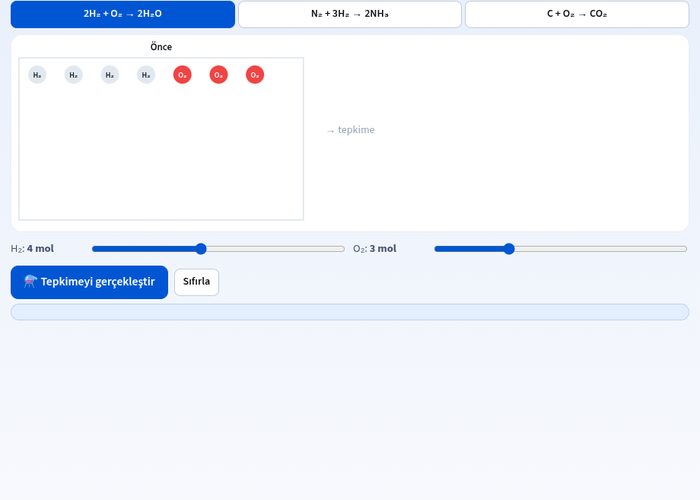
With the chemical calculations simulation, you can interactively learn core topics such as stoichiometry, limiting reactants, and excess substances in chemical reactions. This experiment allows you to observe the conservation of mass and product amount in the particle model by adjusting the mole amounts of the reactants. It is designed for high school and university level chemistry students to clear up misconceptions.
What can you do in this simulation?
You can start the reaction by changing the initial amounts of the reactant substances.
You can visually examine the limiting reactant and the excess reactant using the particle model.
You can calculate the amount of product and the conservation of mass in different reaction scenarios.
You can reinforce your theoretical knowledge by answering questions step by step under guidance.
You can check your calculations by utilizing hints for incorrect answers.
Basic concepts and formulas
Stoichiometry examines the numerical and mass relationships between reactants and products in chemical reactions. The substance that is completely consumed in the reaction is called the "limiting reactant" and determines the amount of product to be formed. While the formula n = m / MA is used in mole calculations, the total mass of the reactants equals the total mass of the products within the framework of the law of conservation of mass.
How to use?
Open the experiment panel and review the guidelines and questions in the guide.
Adjust the amounts of the reactant substances or the reaction parameters.
Observe which substance is limiting using the particle model.
Verify your calculations by pressing the check button and save the results.
Repeat the steps where you fell short, restart the experiment, and try different scenarios.
Frequently asked questions
What is a limiting reactant and how is it found?
A limiting reactant is the substance that is completely consumed in a chemical reaction and therefore limits the amount of product that can be formed. It is easily determined by dividing the initial mole ratios by the coefficients.
How is the law of conservation of mass verified in this simulation?
It is verified at each stage by assuming the total mass of the reactants before the reaction is equal to the total mass of the products and remaining substances after the reaction.
Why are stoichiometric calculations important?
Stoichiometry is vital in industrial productions and laboratory work to prevent waste, reduce costs, and predict exactly how much product will be obtained.
 Interactive experiment