Types of chemical reactions: acid-base (HCl + NaOH, phenolphthalein and temperature), precipitation (AgNO₃ + NaCl, Pb(NO₃)₂ + KI yellow precipitate), oxidation-reduction (zinc + copper sulfate); net ionic equations
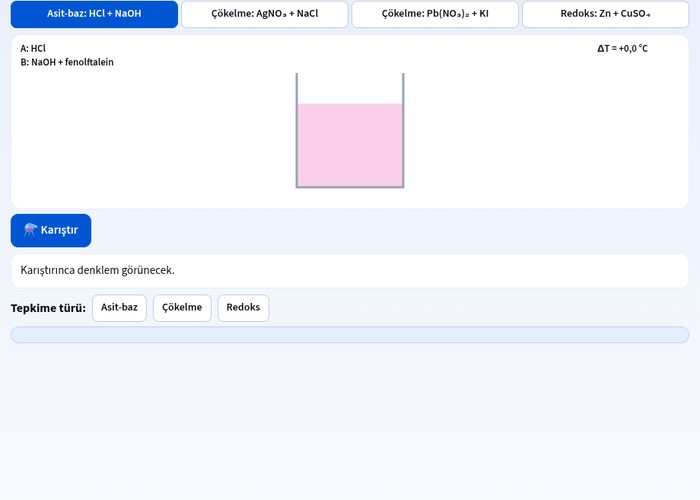
Interactively explore fundamental chemistry reactions such as acid-base, precipitation, and redox with the chemical reaction types simulation. In this interactive experiment, you will examine the HCl + NaOH, AgNO₃ + NaCl, Pb(NO₃)₂ + KI, and Zn + CuSO₄ reactions to learn net ionic equations and observations.
What can you do in this simulation?
- You can observe the interaction of HCl and NaOH solutions as an acid-base reaction, the phenolphthalein color change, and the temperature effect.
- You can examine precipitation reactions with the AgNO₃ + NaCl and Pb(NO₃)₂ + KI systems and see the formation of a yellow precipitate.
- You can test the redox reaction, color changes, and net ionic equations using zinc and copper sulfate (Zn + CuSO₄).
- You can match the reaction types by dragging and dropping or tapping the cards into the appropriate boxes, and check the correct answers with the help of the guide.
Basic concepts and formulas
Chemical reactions are the processes in which substances transform into new substances. While the net ionic equation H⁺ + OH⁻ → H₂O stands out in acid-base reactions, water-insoluble solids (for example, Ag⁺ + Cl⁻ → AgCl(s)) form in precipitation reactions. In oxidation-reduction (redox) reactions, an exchange of electrons takes place.
How to use?
- Open the experiment panel and select one of the four different reaction options.
- Start the reaction and examine the observation results such as color change, temperature, or precipitate.
- Drag the cards to the correct boxes for net ionic equation and reaction type questions.
- Verify your answer by pressing the "Check" button and read the guide tips if you made a mistake.
- Try all steps again using the Restart button and increase your score.
Frequently asked questions
What is the net ionic equation in acid-base reactions?
Generally, the net ionic equation in reactions of strong acids and bases is in the form H⁺ (aq) + OH⁻ (aq) → H₂O (l).
How does the yellow precipitate form in a precipitation reaction?
When lead(II) nitrate and potassium iodide solutions are mixed, water-insoluble yellow lead(II) iodide (PbI₂) solid precipitates.
What is observed in redox reactions?
Electron transfer occurs in oxidation-reduction reactions; for example, in the Zn + CuSO₄ experiment, the deposition of copper on the zinc rod and the fading of the blue color are observed.
 Interactive experiment