Gas laws piston: measure Boyle's (P–V), Charles's (V–T), Gay-Lussac's (P–T), and Avogadro's (V–n) laws with kept-constant variables, draw their graphs
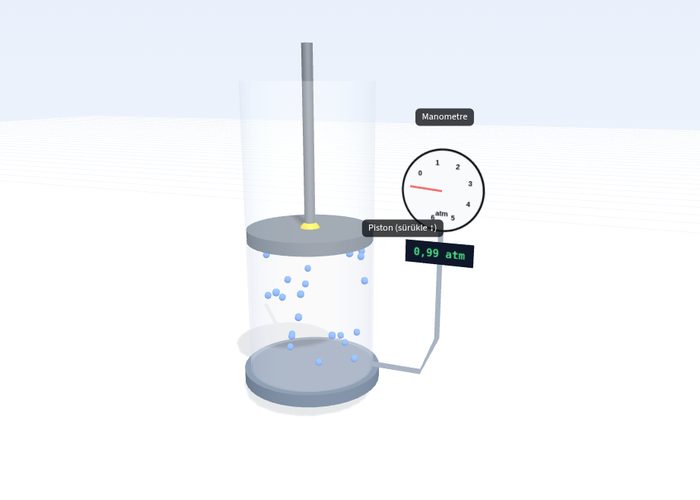
Explore the fundamental ideal gas relationships in chemistry class interactively with the gas laws simulation. In this experiment, you will test Boyle's (P-V), Charles's (V-T), Gay-Lussac's (P-T), and Avogadro's (V-n) laws on piston systems and learn the mathematical relationships between variables.
What can you do in this simulation?
- For Boyle's law, you can keep temperature (T) and mole number (n) constant to examine the pressure-volume (P-V) relationship.
- In Charles's law, you can observe the volume-temperature (V-T) change by keeping pressure and mole number constant.
- Using Gay-Lussac's law, you can take pressure-temperature (P-T) measurements while volume and mole number are constant.
- In Avogadro's law, you can test the direct proportion between volume and mole number (V-n) by keeping pressure and temperature constant.
- You can take at least three measurements for each law to draw graphs and check your results.
Basic concepts and formulas
The ideal gas law explains the behavior of gases in terms of pressure (P), volume (V), temperature (T), and mole number (n). The fundamental relationships examined in this simulation are: P₁·V₁ = P₂·V₂ for Boyle's law, V₁/T₁ = V₂/T₂ for Charles's law, P₁/T₁ = P₂/T₂ for Gay-Lussac's law, and V₁/n₁ = V₂/n₂ for Avogadro's law.
How to use?
- Open the gas laws simulation and select the law you want to study (Boyle's, Charles's, Gay-Lussac's, or Avogadro's).
- Follow the steps in the guide by controlling the variables kept constant.
- Record the data by making the necessary changes on the piston and examine the graphs.
- Test your predictions with the experiment by answering the questions and check your results.
Frequently asked questions
How do pressure and volume change in Boyle's law?
When temperature and mole number are kept constant, pressure and volume are inversely proportional; when the volume is halved, the pressure doubles.
In what unit should temperature be taken in Charles's law?
The Kelvin (K) unit must always be used in temperature calculations within gas laws.
What does Avogadro's law state?
At constant pressure and temperature, the volume of a gas is directly proportional to its number of moles; as the amount of substance increases, the volume also increases.
 Interactive experiment