Kinetic molecular theory of gases: observe gas particles in a closed container; increase in speed and wall collisions (pressure) as temperature rises; compressibility and diffusion
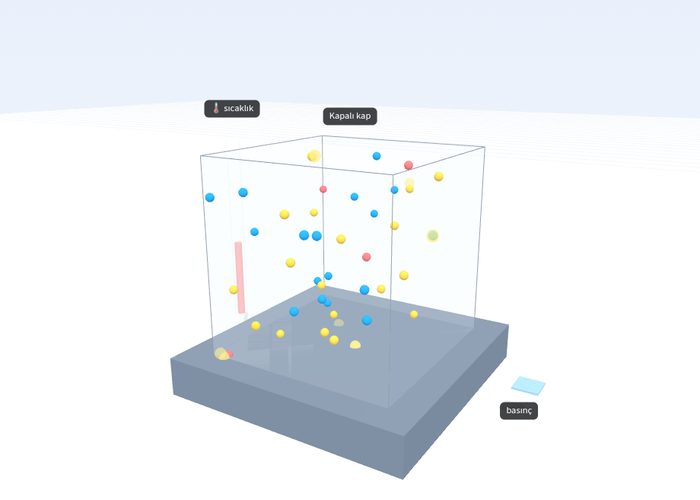
Interactively explore the behaviors of gas particles in a closed container, the effects of temperature changes on molecular velocity, and the concept of pressure with the properties of gases and kinetic molecular theory simulation. Through this experiment, you can learn about the compressibility properties of gases, the relationship between average kinetic energy and temperature, and the differences in motion of different particles. It is a great resource for reinforcing the gas laws and particle theory encountered in high school chemistry courses.
What can you do in this simulation?
You can observe the movements of gas particles in a closed container and their collisions with the walls.
You can examine the effect of temperature increase on particle speed and system pressure.
You can compare the data by conducting experiments with different particle counts and temperature values.
You can test the compressibility and diffusion properties of gases through interactive questions.
Basic concepts and formulas
The kinetic molecular theory states that gas particles are in continuous random motion and the spaces between them are very large. The absolute temperature of gases is directly proportional to their average kinetic energy and is expressed by the formula Ek = (3/2)·k·T. Furthermore, the average speed is proportional to the square root of temperature (Average speed ∝ √T); therefore, gases with smaller mass have a higher speed.
How to use?
Open the simulation screen to examine the initial state of the gas particles in the closed container.
Observe the changes in the system by selecting different temperature values and particle numbers.
Pay attention to the color codes indicating speed changes (blue: slow, orange: medium, red: fast).
Test your predictions with the experiment by answering the guided questions and reinforce your knowledge.
Frequently asked questions
What does average kinetic energy depend on?
Average kinetic energy depends solely on absolute temperature. As the temperature increases, the average kinetic energy of the particles also increases.
Why do some gas particles move faster?
At the same temperature, the average kinetic energy of all gases is equal. However, particles with a smaller mass (e.g., He) have a higher velocity as required by the formula.
How is gas pressure created?
A force is generated as a result of the elastic collisions of gas particles with the container walls, and the ratio of this force to the surface area produces gas pressure.
 Interactive experiment