Indicators of chemical change: experiment with mixtures such as carbonate + vinegar, iron powder + oxygen, copper sulfate + sodium hydroxide, burning of sugar; observe gas evolution, color changes, precipitates, heat, and light; differentiation of physical and chemical changes
With the indicators of chemical change simulation, you can examine examples from daily life such as carbonate and vinegar, the dissolution of sugar in water, or the souring of milk. Thanks to this interactive experiment, you will easily grasp the difference between physical and chemical change by observing the changes in the internal structure of substances.
What can you do in this simulation?
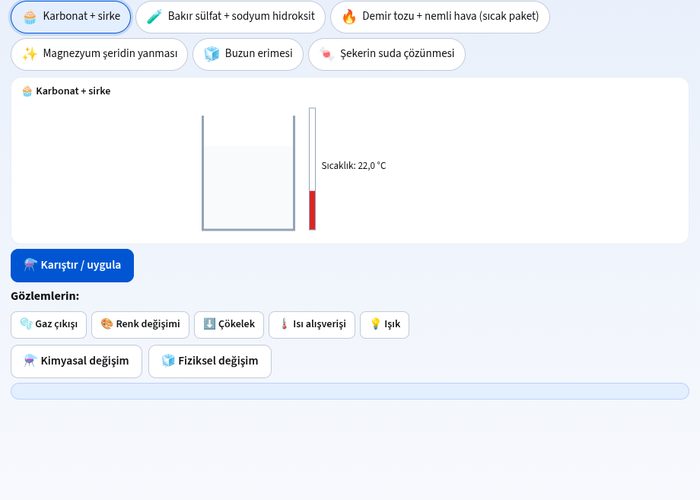
You can select different mixtures and events, such as carbonate and vinegar, milk souring into yogurt, or ice melting.
You can observe and mark signs such as gas evolution, color change, precipitate formation, heat exchange, and light.
You can place the cards into the correct boxes by dragging and dropping or by touching.
You can decide whether the change you selected is physical or chemical and test your predictions.
By following the steps with the guide, you can reach the correct answers and complete your shortcomings.
Basic concepts and formulas
In a physical change, only the outer appearance or physical state of the substance changes, while its internal structure (identity property) is preserved. For example, melting ice or dissolving sugar in water is physical. In a chemical change, however, the internal structure of the substance changes and new substances are formed; this condition is understood through indicators such as gas evolution, color change, precipitate formation, and the emission of heat or light. Bubbles (gas evolution) observed in the mixture of carbonate and vinegar are a typical example of a chemical change.
How to use?
Select a mixture or event from the list that you want to examine.
Mark the observations that emerge when the event occurs (gas evolution, color, precipitate, heat, or light).
Decide whether the change is physical or chemical and drag the card to the corresponding box.
Test your prediction by pressing the check answer button and see the correct results.
Move on to other mixtures to classify all 6 different events and complete the experiment.
Frequently asked questions
How to distinguish between physical and chemical change?
In a physical change, the identity of the substance does not change and it can be reversed; whereas in a chemical change, new substances are formed and permanent signs such as color change, gas evolution, and heat exchange are observed.
Why is the mixture of carbonate and vinegar a chemical change?
As a result of this mixture, gas evolution (carbon dioxide) is observed along with effervescence, and the internal structure of the substances changes to form new substances.
Why is the dissolution of sugar in water not chemical?
Sugar molecules are only physically dispersed in water; since the molecular structure is not disrupted and sugar can be recovered by evaporating the water, this event is a physical change.
 Interactive experiment