Equation balancing workshop: balance six reactions by increasing and decreasing coefficients; instantly compare the number of atoms of each element in reactants and products; conservation of mass
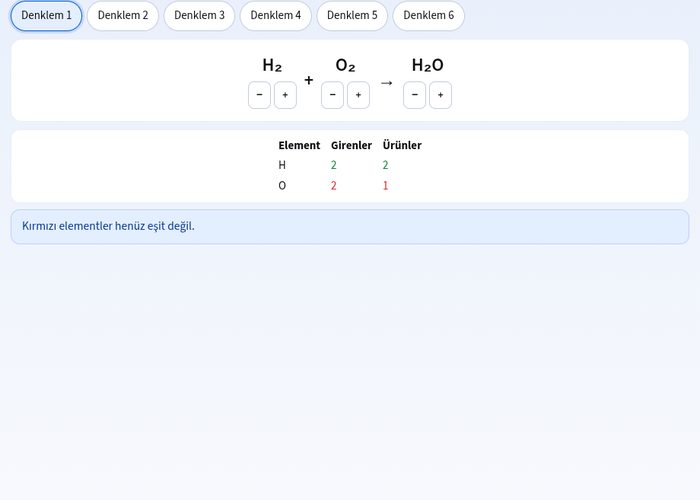
Interact and practice the law of conservation of mass with the chemical reaction equation balancing simulation. In this chemistry experiment, you can instantly compare the number of atoms between reactants and products by changing coefficients in different chemical equations. It is designed for high school and university students to reinforce equation balancing, which is one of the most fundamental skills in chemistry.
What can you do in this simulation?
You can balance six different chemical reactions step by step.
You can instantly observe the number of atoms in reactants and products by increasing and decreasing coefficients.
You can track changes in the number of molecules, number of atoms, total mass, and number of moles.
You can instantly check your moves with feedback like Correct! or Think again.
You can benefit from strategic tips (such as the rule of starting with the most complex molecule) accompanied by a guide.
Basic concepts and formulas
In a chemical reaction, the number and types of atoms of the reactants must be exactly the same as the number and types of atoms of the products. This is a consequence of the Law of Conservation of Mass. For example, in the propane combustion equation, equality is achieved by determining the coefficients as C₃H₈ + 5O₂ -> 3CO₂ + 4H₂O. When balancing, starting with the most complex structured molecule and leaving single elements to the very last is the most effective strategy.
How to use?
Go to the experiment panel and select one of the six equations that appear.
Read the strategy tips and determine the appropriate coefficients starting with the most complex molecule.
Use the relevant buttons to increase and decrease the coefficients.
Compare the number of atoms between the reactants and products and press the check button.
See the success message when all equations are balanced and press the restart button to repeat if necessary.
Frequently asked questions
What do coefficients mean in chemical reactions?
Coefficients show how many moles or molecules of that substance participate. Balancing can never be done by changing the subscripts in the formula, only the coefficients in front of them are changed.
Why should we start with the most complex molecule first?
Since the most complex molecule contains the most different atoms, fixing its coefficient makes it easier to determine the coefficients of other elements (especially common elements like hydrogen and oxygen).
How is the law of conservation of mass seen in the simulation?
When the total number of atoms of the reactants is equalized with the total number of atoms of the products, the system is balanced, which shows that the total mass is conserved.
 Interactive experiment