Theme 1: Interaction
grade 10 chemistry · theme 1
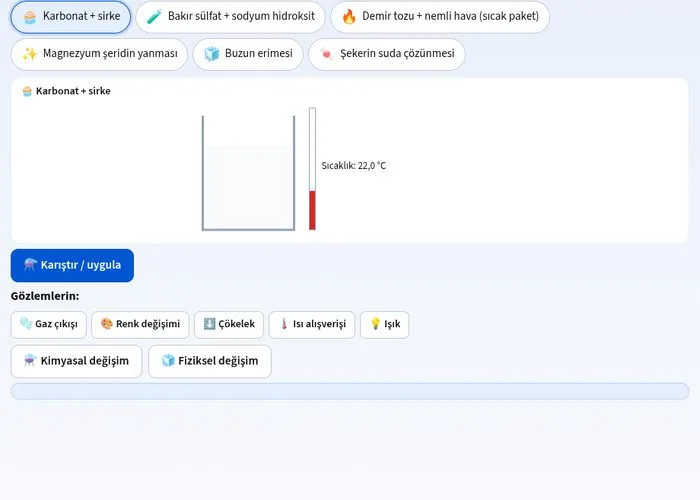
1.1.1 Indicators of Chemical Change
Indicators of chemical change: experiment with mixtures such as carbonate + vinegar, iron powder + oxygen, copper sulfate + sodium hydroxide, burning of sugar; observe gas evolution, color changes, precipitates, heat, and light; differentiation of physical and chemical changes
Open Simulation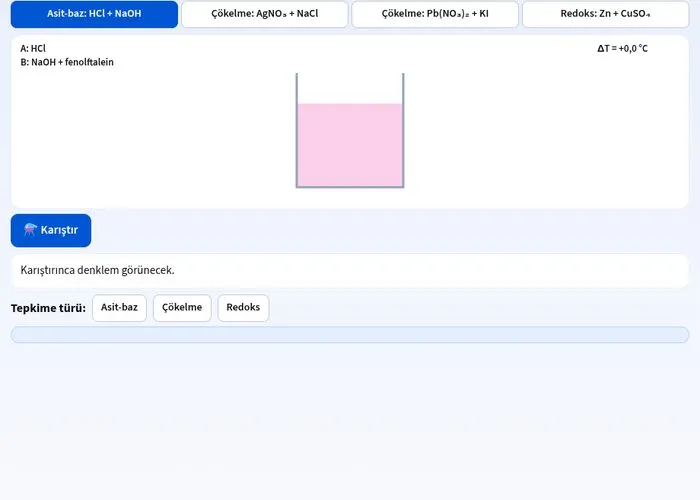
1.1.2 Types of Chemical Reactions
Types of chemical reactions: acid-base (HCl + NaOH, phenolphthalein and temperature), precipitation (AgNO₃ + NaCl, Pb(NO₃)₂ + KI yellow precipitate), oxidation-reduction (zinc + copper sulfate); net ionic equations
Open Simulation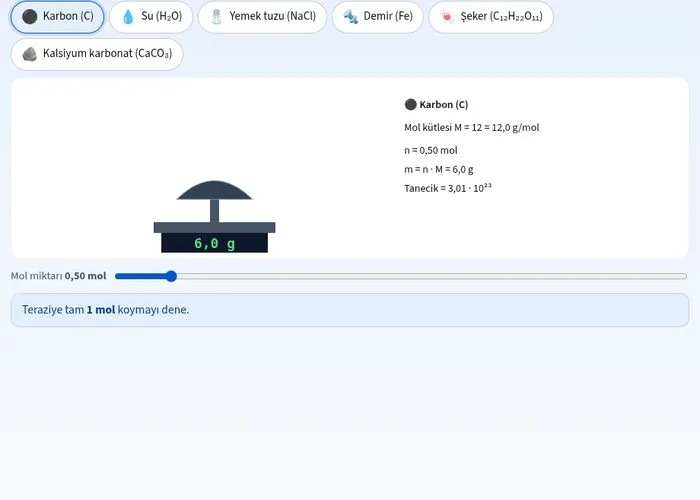
1.1.3 The Mole Concept
Mole concept: weigh 1 moles of different substances (C, H₂O, NaCl, Fe, sugar); mole-mass-number of particles conversions, Avogadro's number, molar mass calculation
Open Simulation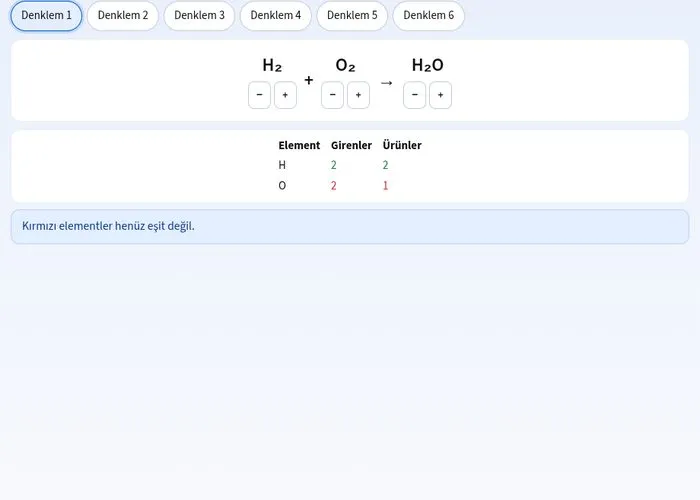
1.1.4 Balancing Chemical Reaction Equations
Equation balancing workshop: balance six reactions by increasing and decreasing coefficients; instantly compare the number of atoms of each element in reactants and products; conservation of mass
Open Simulation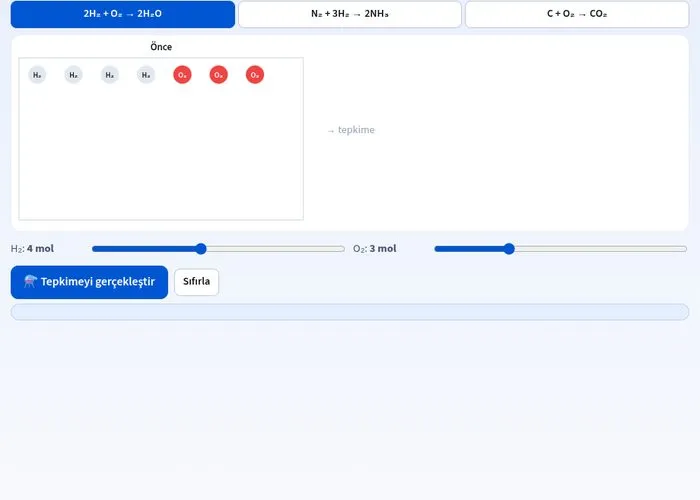
1.1.5 Chemical (Stoichiometric) Calculations
Stoichiometry: adjust the mole amounts of reactants, observe the limiting and excess components in the particle model; product amount, mass conservation, and percentage yield calculations
Open Simulation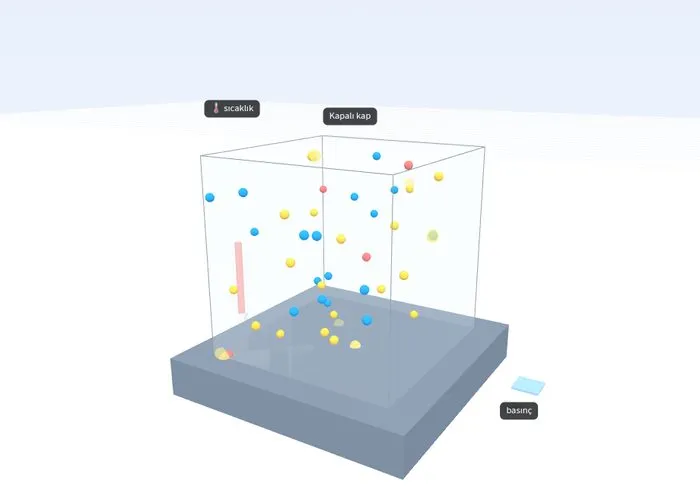
1.2.1 Properties of Gases and Kinetic Molecular Theory
Kinetic molecular theory of gases: observe gas particles in a closed container; increase in speed and wall collisions (pressure) as temperature rises; compressibility and diffusion
Open Simulation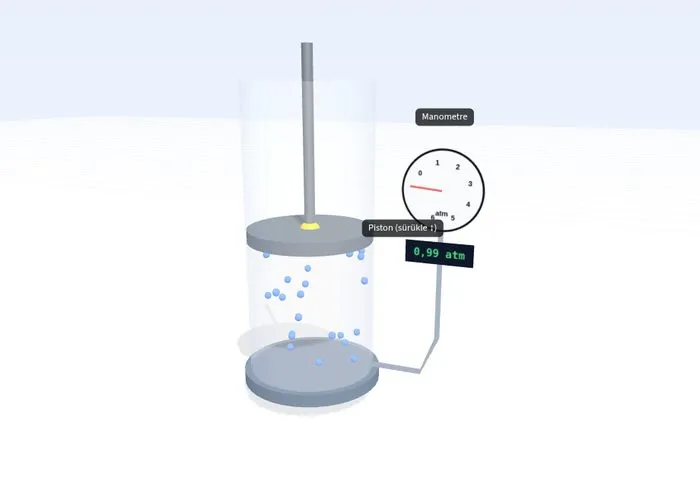
1.2.2 Gas Laws
Gas laws piston: measure Boyle's (P–V), Charles's (V–T), Gay-Lussac's (P–T), and Avogadro's (V–n) laws with kept-constant variables, draw their graphs
Open Simulation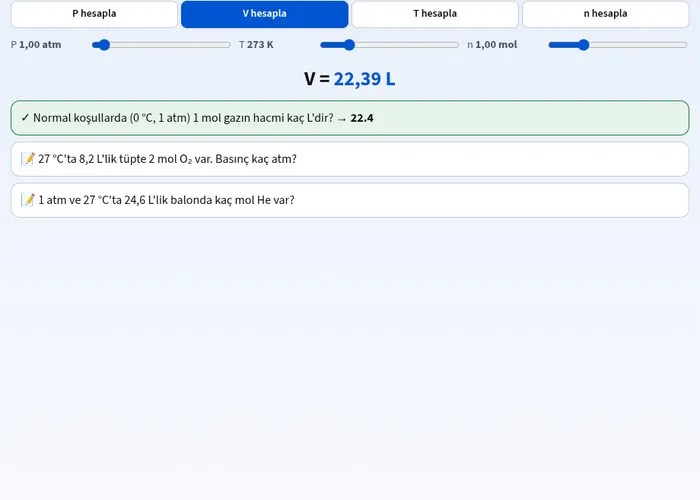
1.2.3 Ideal Gas Law
Ideal gas law PV = nRT: set three of the four variables, calculate the fourth; 1 moles of gas occupying a volume of 22,4 L under standard conditions; balloon and cylinder problems
Open Simulation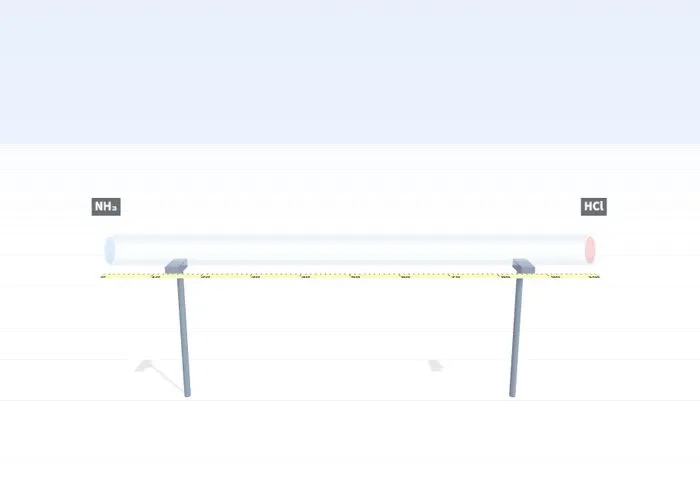
1.2.4 Graham's Law of Diffusion and Effusion
Graham's law of diffusion: send NH₃ and HCl gases from both ends of a glass tube, find where the white NH₄Cl ring forms; speed ∝ 1/√M; effusion race with different gas pairs
Open Simulation