Mole concept: weigh 1 moles of different substances (C, H₂O, NaCl, Fe, sugar); mole-mass-number of particles conversions, Avogadro's number, molar mass calculation
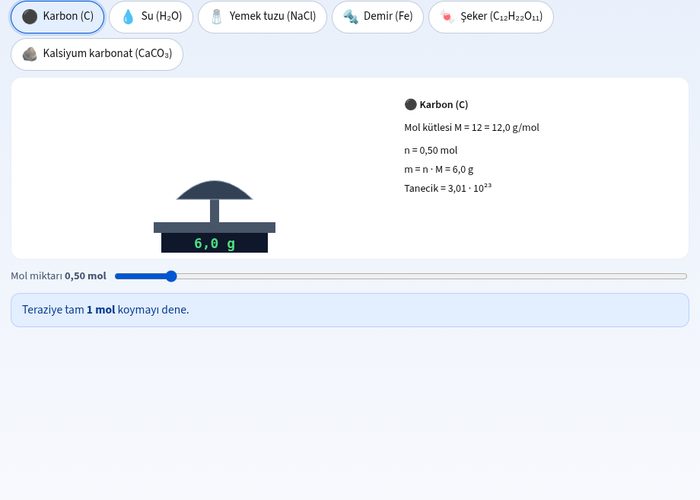
With the mole concept simulation, you can interactively explore the relationships between the mole, mass, and number of particles, which is one of the most fundamental topics in chemistry. In this experiment, you will learn the molar masses of substances and their connections to Avogadro's number by weighing 1 moles of different substances such as Carbon (C), Iron (Fe), and water.
What can you do in this simulation?
- You can weigh 1 moles on the scale by selecting Carbon, Iron, and other substances.
- You can observe the mass differences by weighing 1 mole of each of the 6 different substances.
- You can answer questions about mole-mass conversions and test your predictions.
- You can reinforce the mole concept by progressing step by step with the guide.
- You can reset the experiment using the Restart button and try again with different substances.
Basic concepts and formulas
In chemistry, the unit that bridges the number of particles with the macroscopic world is the mole. 1 mole of a substance contains as many particles (atoms, molecules, or ions) as Avogadro's number (N_A = 6.022 · 10^23). The molar mass (MA) of a substance is expressed in grams/mole. The basic relations are:
- n = m / MA (n: number of moles, m: mass, MA: molar mass)
- N = n · N_A (N: number of particles)
How to use?
- Go to the experiment panel and examine the substances to be weighed.
- Perform a 1-mole weighing on the scale by selecting cards or substances.
- Record your predictions by following the questions and prompts that appear on the screen.
- Check the results and reinforce your knowledge with the correct answers.
Frequently asked questions
Why is the mass of 1 moles of each substance different?
Since the atomic and molecular weights of each element or compound are different, the masses in grams of 1 moles of substances are also different; however, the number of particles in all of them is equal to Avogadro's number.
What is Avogadro's number?
Avogadro's number is a universal constant that gives the number of particles in 1 moles of a substance and is accepted as 6.022 · 10^23.
What should I pay attention to in mole concept calculations?
You must ensure that the mass units are in grams and that the atomic weights of the elements are correctly added up when calculating the molar mass for compounds.
 Interactive experiment