Ideal gas law PV = nRT: set three of the four variables, calculate the fourth; 1 moles of gas occupying a volume of 22,4 L under standard conditions; balloon and cylinder problems
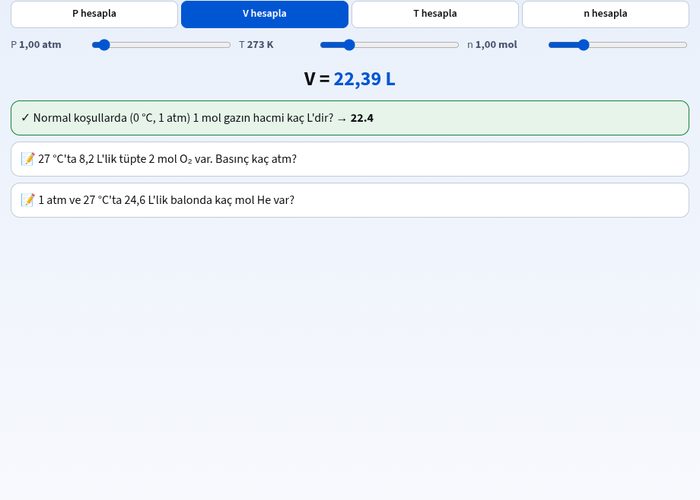
Explore the relationships between pressure, volume, temperature, and number of moles interactively with the ideal gas law simulation. In this experiment, you can adjust three of the four variables to calculate the fourth and learn about the behavior of gases under standard conditions. It is an excellent tool for reinforcing gas laws in chemistry class.
What can you do in this simulation?
You can select the variable you want to calculate and easily adjust the other three parameters.
You can perform real gas calculations using balloon and tube problems.
You can test the correct answers by proceeding step by step with the guide.
You can reinforce your theoretical knowledge with practice using drag-and-drop cards or multiple-choice questions.
Basic concepts and formulas
The ideal gas law combines the macroscopic properties of gases into a single equation. The basic formula is P·V = n·R·T. Here, P represents pressure, V represents volume, n represents the number of moles, R represents the ideal gas constant, and T represents the absolute temperature in Kelvin.
How to use?
Go to the experiment panel and select the target variable you want to calculate.
Set the values of the other three given variables within the desired ranges.
Examine the problem cards, make your prediction, and press the check button.
Analyze the results, review the missing steps, and repeat the experiment.
Frequently asked questions
What is the formula for the ideal gas law?
The formula is P·V = n·R·T. It shows the mathematical relationship between pressure, volume, number of moles, and temperature.
How much volume does 1 moles of gas occupy under standard conditions?
Under standard conditions (0 °C and 1 atm), 1 moles of all ideal gases occupy a volume of 22,4 liters.
What kind of problems can I solve in this simulation?
You can calculate pressure and volume changes of gases such as O2 and He with different mole numbers using balloon and tube problems.
 Interactive experiment