Nephron journey: follow glucose, water, Na⁺, urea, protein and red blood cells from the glomerulus to urine; see the steps of filtration, reabsorption and secretion; calculate the formation of 1,5 L of urine from 180 L of filtrate per day
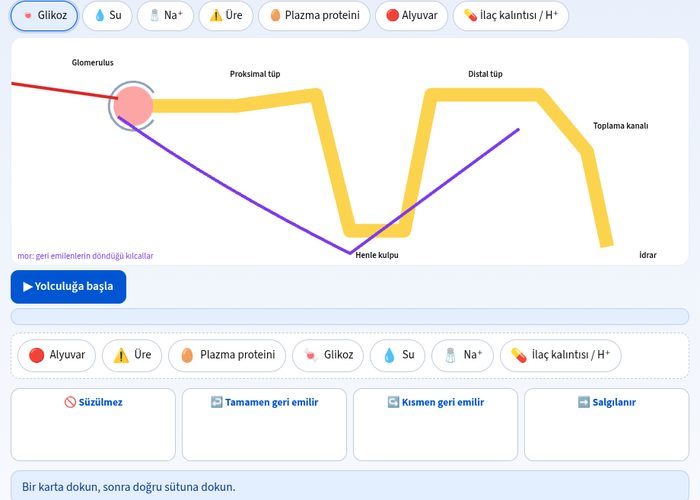
This interactive experiment offers a great opportunity to discover the critical role of the excretory system in body balance. With the help of this homeostatic function of the excretory system simulation, you will learn the path followed by substances such as glucose, water, Na⁺, urea, plasma protein, and drug residues along the nephron. By examining the steps of filtration, reabsorption, and secretion firsthand, you will grasp the change in the amount of filtrate produced per day versus urine.
What can you do in this simulation?
You can track 7 different substances (glucose, water, urea, red blood cells, plasma protein, etc.) along the nephron journey.
You can examine the stages of Bowman's capsule, proximal tubule, loop of Henle, distal tubule, and collecting duct.
You can classify the fates of substances into filtration (filt), reabsorption (reab), and secretion (sec).
You can place cards into the correct boxes by dragging and dropping or touching them, and receive instant feedback guided by the assistant.
You can track your score, make use of hints on steps where you get stuck, and repeat the experiment.
Basic concepts and formulas
The excretory system maintains internal body balance (homeostasis) by filtering the blood and removing harmful substances. The fluid passing from the glomerulus into Bowman's capsule via filtration in the nephrons undergoes reabsorption and secretion processes along the tubules. While approximately 180 L of filtrate is formed daily, the greater part of this is reabsorbed, and about 1,5 L of urine is excreted.
How to use?
Go to the experiment panel and follow the "Next" or "Guide" steps.
Touch or drag the tracked substance cards and place them into the relevant nephron segments.
Examine the filtration and reabsorption rates of each substance to select the correct column or box.
Test your answer by pressing the check button and read the explanations from the Raista mascot.
Frequently asked questions
Why are plasma proteins not found in urine?
Because plasma proteins are large molecules, they cannot be filtered from the glomerulus into Bowman's capsule in a healthy nephron and remain in the blood.
In which nephron region does reabsorption occur the most?
The reabsorption of water and useful substances mainly takes place in the proximal tubule and the relevant parts of the loop of Henle.
What is the function of secretion?
Urine formation is finalized by transferring substances such as certain drug residues and H⁺ ions from the capillaries to the nephron tubules via active transport.
 Interactive experiment