Capillary exchange (Starling): balance filtration and reabsorption at the arterial and venous ends of the capillary using blood pressure and plasma protein sliders; discover edema formation and the role of the lymphatic system
2.6 Interactively explore substance exchange in capillaries, blood pressure, and Starling's hypothesis with the Circulatory System and Homeostasis simulation. In this experiment, you will examine the balance of filtration and reabsorption at the arterial and venous ends, learning about edema formation and the role of the lymphatic system.
What can you do in this simulation?
You can examine the filtration process taking place from the arterial end toward the tissue.
You can observe the mechanisms of reabsorption into the blood at the venous end.
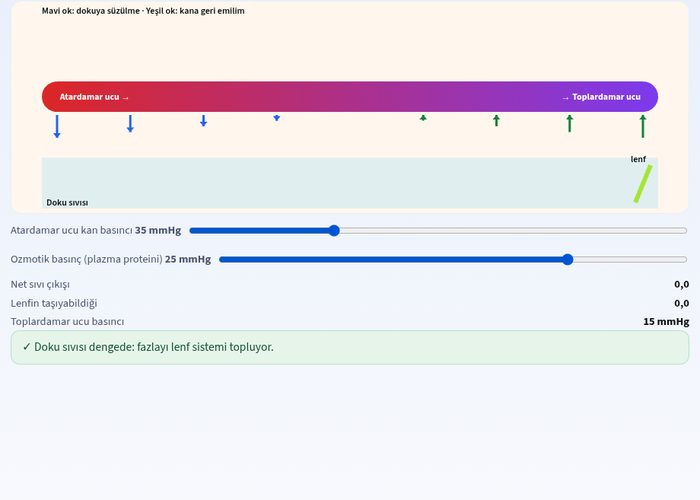
You can follow filtration into the tissue with blue arrows and reabsorption into the blood with green arrows.
You can test the effects of changes in blood pressure and plasma proteins on the balance.
You can reinforce your knowledge by answering questions about edema formation and the functioning of the lymphatic system.
Basic concepts and formulas
The exchange of substances between the capillary and the tissue fluid is explained by Starling's balance. While blood hydrostatic pressure pushes fluid out of the vessel (filtration), the blood's osmotic pressure pulls fluid into the vessel (reabsorption). Filtration occurs at the arterial end because blood pressure is higher than osmotic pressure, whereas reabsorption occurs at the venous end because osmotic pressure is higher.
How to use?
Go to the experiment panel and read the guided steps regarding capillary balance.
Record your prediction for the scenarios you encounter in the question and prediction area.
Examine the pressure changes and arrow directions between the arterial end and the venous end.
Complete the matches by dragging and dropping or tapping the cards into the appropriate boxes.
Verify your answers by clicking the check button and review your missing points.
Frequently asked questions
Why does filtration occur at the arterial end?
At the arterial end, because blood pressure is higher than the osmotic pressure of the blood, water and dissolved substances pass from the capillary into the tissue fluid.
How is fluid reabsorbed at the venous end?
As blood flows along the capillary, blood pressure drops, but the osmotic pressure created by plasma proteins remains constant. Since osmotic pressure becomes greater than blood pressure at the venous end, fluid is reabsorbed from the tissue back into the blood.
How does edema form and what does the lymphatic system do here?
Edema forms when excess fluid accumulating in the tissue cannot return to the circulation; under normal conditions, this excess fluid is collected by the lymphatic system and returned to the blood.
 Interactive experiment