Negative and positive feedback: step-by-step exercise and graph comparison of error correction in the thermostat loop versus amplifying effects in the oxytocin loop during childbirth; classify examples
Prepared to help you better understand homeostasis mechanisms, this positive and negative feedback simulation allows you to interactively explore how our body maintains its internal balance. With this experiment included within the scope of the 11th-grade biology course 2st Theme, you can run and compare negative feedback mechanisms that correct deviations, such as the thermostat cycle, and positive feedback processes that continue by amplifying the effect, such as the oxytocin cycle in childbirth, step by step with graphs.
What can you do in this simulation?
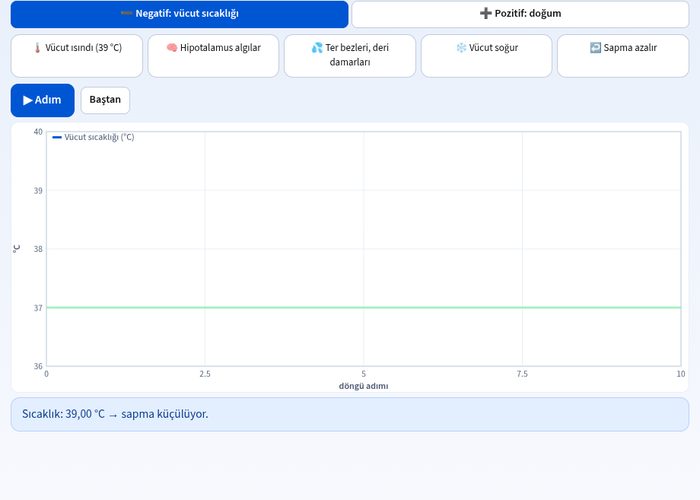
You can observe how the temperature returns to 37 °C by following the body warming and sweating steps in the negative feedback loop.
You can examine how uterine contractions increase at each step with the baby's pressure, hypothalamus-pituitary stimulation, and oxytocin secretion in the positive feedback loop.
You can classify different biological examples such as sweating when the body heats up, insulin secretion when blood sugar rises, an increase in oxytocin during childbirth, and blood clotting by dragging and dropping them into the relevant boxes and columns.
You can grasp the fundamental differences between negative and positive feedback by comparing the ending events and deviation graphs at the conclusion of both cycles.
Basic concepts and formulas
The maintenance of a stable internal balance (homeostasis) in living organisms is provided by feedback loops. In negative feedback, any deviation in the system is detected, a response in the opposite direction is generated, and the condition is pulled back to the initial ideal value (e.g., temperature rise -> sweating -> drop in temperature). In positive feedback, however, the generated response intensifies the initial stimulus, causing the process to accelerate or grow; it usually ends with an external event (such as birth) (e.g., oxytocin secretion -> uterine contraction -> increase in pressure).
How to use?
Select negative or positive feedback loops from the experiment panel and run the steps through to the end.
Observe changes in graphs and values, such as a drop in body temperature or an increase in contraction intensity.
Examine the 7 different biological events (blood sugar, milk secretion, blood clotting, etc.) provided in the sample classification section.
Place the cards into the correct positive or negative feedback boxes by tapping or dragging and dropping them.
Verify your answers by pressing the check button and review your gaps with the help of the Guide.
Frequently asked questions
What is the purpose of negative feedback in the body?
Negative feedback aims to prevent any variable in the body from deviating from its normal value (set point) and to keep the system in a stable balance (homeostasis).
Why doesn't positive feedback continue to increase indefinitely?
Positive feedback processes amplify the effect until a target or external event occurs (such as the birth of a baby or the formation of a clot), and the cycle is terminated as a result of this event.
Why is the thermostat model an example of negative feedback?
Because when room temperature deviates from the desired value, the system operates to bring the temperature back to the initial ideal level and eliminates the deviation.
 Interactive experiment