Hypothalamus control room: keep the body in balance by choosing the correct neural and hormonal responses in cold, hot, thirst, hunger and danger scenarios; the role of the sympathetic and parasympathetic systems in homeostasis
Discover how the nervous system and hormones work together to maintain our body's internal balance with the homeostasis simulation. You will learn to manage the hypothalamus control room and match the correct physiological responses in different scenarios such as cold, heat, thirst, hunger, and danger.
What can you do in this simulation?
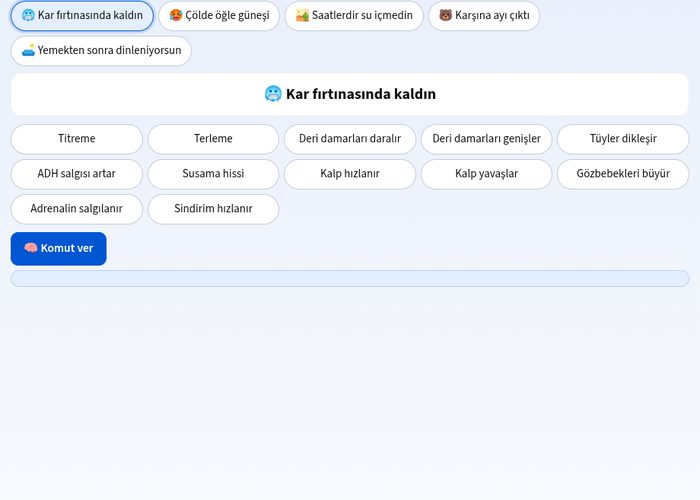
You can examine 5 different life scenarios such as a snowstorm, desert sun, thirst, danger, and rest.
You can place the cards into the correct boxes by dragging and dropping or by touching.
You can observe the fight-or-flight response of the sympathetic system and the rest-and-digest responses of the parasympathetic system.
You can test under which conditions responses such as skin blood vessels, hair erection, heart rate, and ADH secretion are activated.
You can reset the simulation with the restart button and try your decisions again.
Basic concepts and formulas
Homeostasis is the maintenance of a stable and balanced internal environment. The hypothalamus in our brain is the main control center in this process. While the nervous system produces rapid and short-term electrical signals in response to environmental changes, the endocrine system (e.g., ADH and adrenaline hormones) provides slower but longer-term chemical responses. While the sympathetic system is activated in fight-or-flight situations, the parasympathetic system dominates during rest.
How to use?
Start by selecting one of the scenarios and read the situation presented.
Examine the cards to determine which physiological response belongs to the relevant situation.
Place the cards into the correct boxes by tapping or dragging and dropping them.
Verify your selections and get instant feedback by pressing the check button.
Repeat the experiment by reviewing any missing or incorrect steps.
Frequently asked questions
What role does the hypothalamus assume in homeostasis?
The hypothalamus is the main control center that regulates internal environment variables such as body temperature, water balance, and blood sugar.
What is the difference between the sympathetic and parasympathetic systems?
While the sympathetic system triggers the fight-or-flight response in times of danger, the parasympathetic system supports rest-and-digest processes.
What does the ADH hormone do in times of thirst?
ADH (antidiuretic hormone) increases water reabsorption from the kidneys, reducing urine output and maintaining water balance in the body.
 Interactive experiment