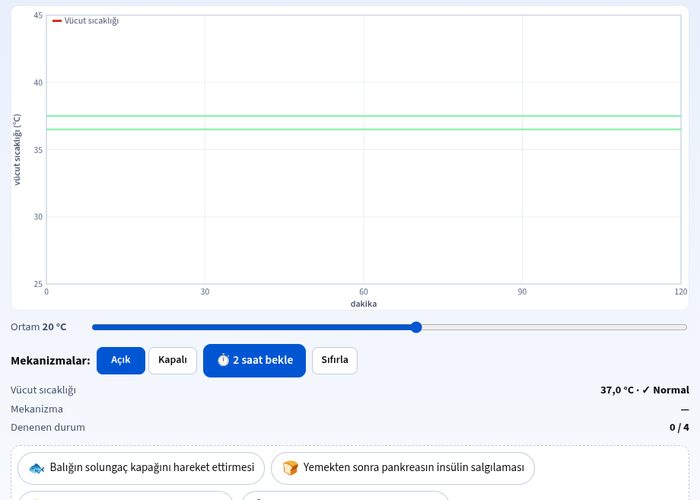
Homeostasis thermostat: change the ambient temperature between −10 °C and 45 °C; compare how body temperature changes over time in the graph when regulatory mechanisms are on and off; classify homeostatic balance adaptations in living things
With this homeostasis simulation, where you will examine the mechanisms by which living things maintain their internal balance, you can learn biology topics interactively. By changing the ambient temperature and testing regulatory mechanisms, you will observe the time-dependent change in body temperature on a graph.
What can you do in this simulation?
You can easily set the ambient temperature between −10 °C and 45 °C.
You can examine the body temperature's response by turning the regulatory mechanisms on and off.
You can place and classify homeostatic adaptations and examples in living things into the correct boxes.
You can track border conditions such as hypothermia and hyperthermia via graphs and warnings.
You can reinforce your knowledge by answering questions with the guidance of the guide.
Basic concepts and formulas
Homeostasis is an organism's maintenance of a stable and balanced internal environment despite changes in the external environment. Living things keep their body temperatures within an ideal range (for example, approximately 36,5–37,5 °C in humans) thanks to thermoregulation. When the ambient temperature goes beyond these limits, shivering, sweating, vascular movements, and behavioral adaptations come into play.
How to use?
Set the external environmental conditions using the ambient temperature slider.
Start the simulation by selecting the status of the regulatory mechanisms.
Monitor the change in body temperature over time and the curves on the graph.
Drag and drop the cards to place the homeostatic adaptations into the correct categories.
Frequently asked questions
What is homeostasis and why is it important for living organisms?
Homeostasis is the maintenance of internal balance and makes cellular survival possible by providing the optimal environment for enzymes to function best.
How does the body react when the ambient temperature drops significantly?
When regulatory mechanisms are active, heat is generated and conserved through responses such as shivering and vasoconstriction; if the mechanism is absent, there is a risk of hypothermia.
What methods do living organisms use to achieve homeostasis?
From unicellular organisms to mammals, physiological and behavioral adaptations such as contractile vacuoles, sweating, fluffing feathers, and water storage are used.
 Interactive experiment