Water and electrolyte balance: drink water, eat salty food, sweat during exercise; how do blood plasma density, hypothalamus–ADH and thirst sensation, urine volume and density change? Body temperature, blood pressure and toxin excretion processes
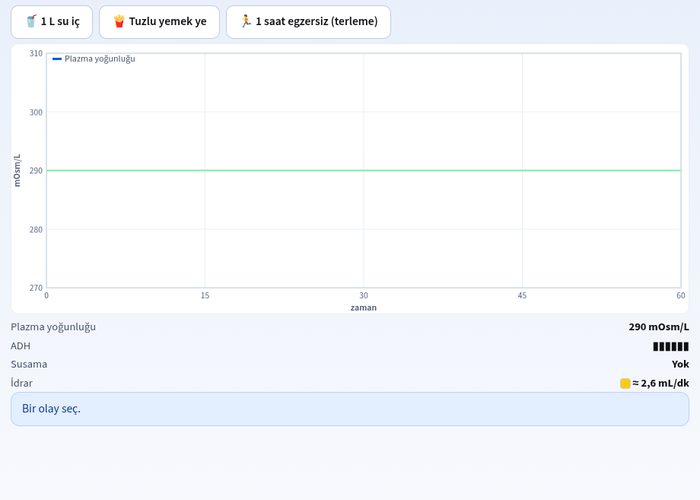
Interactively discover how the body maintains its water and electrolyte balance with the homeostatic processes simulation. In this experiment, you will examine how blood plasma density, the hypothalamus-ADH mechanism, and the sensation of thirst change during situations like drinking water, eating salty food, and sweating. A great opportunity to reinforce the topic of homeostasis in biology class.
What can you do in this simulation?
You can test different scenarios affecting water and electrolyte balance.
You can test your knowledge by dragging and dropping cards or matching them to the correct boxes.
You can observe the body's responses to conditions such as scant and dark urine, or copious and dilute urine.
You can record your predictions and receive instant feedback to see where you made mistakes.
You can explore the experiment panel by proceeding step-by-step with the guidance of the guide.
Basic concepts and formulas
Homeostasis is the ability of living organisms to keep their internal environment stable and balanced. Hypothalamus osmoreceptors and ADH (antidiuretic hormone) play critical roles in water balance. When blood osmolarity increases, ADH release increases, water reabsorption from the kidneys accelerates, and the amount of urine decreases and becomes concentrated.
How to use?
Go to the experiment panel and carefully read the instructions and the guide.
Record your prediction based on the given scenarios and start the process.
Place the cards by tapping or dragging them into the appropriate boxes or columns.
Test your answer with the "Check" button and examine the correct results.
Start over and retry the steps where you made mistakes or fell short.
Frequently asked questions
What is homeostasis?
It is the mechanism by which a living organism keeps its internal balance within stable limits despite external environmental changes.
How does the ADH hormone affect the kidneys?
ADH reduces water excretion from the body and concentrates urine by increasing the water permeability of the kidney tubules.
Which course is this simulation suitable for?
it is a perfect fit for the water balance and homeostasis topics in the grade biology curriculum.
 Interactive experiment