Blood sugar simulator: add breakfast, dessert, exercise and fasting events over a course of a day; observe insulin and glucagon maintaining glucose in the 70–110 mg/dL range; match endocrine glands with their hormones
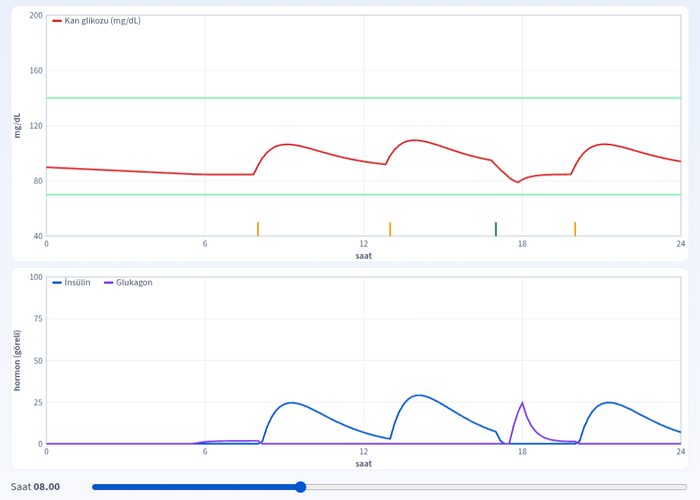
Explore the homeostasis function of the endocrine system with the blood sugar simulator and interactively examine the vital balance of hormones in your body. In this simulation, you will observe how insulin and glucagon regulate glucose levels by adding daily events such as breakfast, sweets, exercise, and fasting. A great experience awaits you to reinforce the topics of grade 11 biology course, theme 2 homeostasis.
What can you do in this simulation?
You can select the time and add eating, exercise, and fasting events throughout the day.
You can monitor blood sugar changes by comparing the insulin and glucagon curves.
You can see how glucose is maintained within the normal range of 70-110 mg/dL.
You can examine the effects of diabetes on the body by playing through the day in diabetes mode.
You can complete the endocrine map by placing endocrine glands and hormones (Insulin, ADH, Growth hormone, etc.) into the correct boxes.
Basic concepts and formulas
Homeostasis is the maintenance of internal balance within a stable limit. Two main antagonistic (working in opposition) hormones play a role in the regulation of blood sugar: while insulin lowers blood sugar, glucagon raises it by converting glycogen in the liver into glucose. Additionally, calcitonin and parathyroid hormone form a similar antagonistic pair in calcium balance. The normal blood glucose range is generally between 70-110 mg/dL.
How to use?
Select the time from the blood sugar simulator screen and add events appropriate to the flow of the day (breakfast, exercise, etc.).
Follow the changes in the insulin and glucagon curves on the graph by playing the day.
Observe metabolic differences by activating the diabetes mode.
Match 10 different hormones with the correct endocrine glands by dragging and dropping or tapping the cards.
Frequently asked questions
Why do insulin and glucagon work antagonistically?
Because while insulin lowers blood sugar by enabling glucose uptake into cells, glucagon does the exact opposite by breaking down glycogen in the liver to release glucose into the blood, causing blood sugar to rise. This opposing action keeps blood sugar stable between 70-110 mg/dL.
What changes on the graph in diabetes mode?
In cases where the pancreas cannot produce enough insulin or cells show resistance to insulin, glucose balance is disrupted, and blood sugar rises above the normal range, following an unstable course.
What other examples can be given for antagonistic hormone pairs?
Calcitonin, secreted by the thyroid gland, and parathyroid hormone, secreted by the parathyroid gland, are another important antagonistic hormone pair that maintains calcium balance.
 Interactive experiment