Respiratory control: increase exercise intensity, hold your breath or hyperventilate; track changes in blood CO₂, pH and O₂ on a graph along with how the medulla oblongata adjusts breathing rate
Interactively discover how the body maintains its internal balance with the role of the respiratory system in homeostasis simulation. In this experiment, you will test different breathing conditions and observe blood gas changes and medulla oblongata interaction.
What can you do in this simulation?
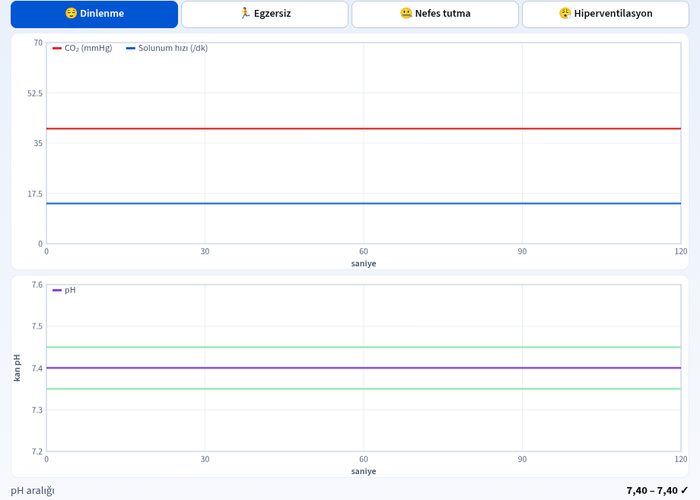
You can try 4 different conditions: resting, exercise, breath-holding, and hyperventilation.
You can monitor changes in respiratory rate in real-time by increasing the exercise intensity.
You can track the fluctuations in blood CO₂, pH, and O₂ levels when you hold your breath or breathe rapidly.
You can examine how the medulla oblongata adjusts the respiratory rate through graphs.
Basic concepts and formulas
Homeostasis is the maintenance of the body's internal balance within stable limits. The respiratory system protects the acid-base balance of the blood by balancing the amount of CO₂ accumulated in the blood and the corresponding pH value. The strongest factor stimulating the respiratory center is the increase of CO₂ in the blood and the proliferation of H⁺ ions associated with it, leading to a drop in pH. The fundamental equation can be summarized as follows: CO₂ + H₂O ⇌ H₂CO₃ ⇌ H⁺ + HCO₃⁻.
How to use?
Select a condition from the activity panel (Resting, Exercise, etc.).
Monitor blood values and respiratory rate from the graphs on the screen for 2 minutes.
Compare the results by applying different scenarios (holding breath or rapid breathing).
Test your knowledge by completing the cards and questions, and return to the guide.
Frequently asked questions
What is the strongest stimulating factor for the respiratory center?
The most suppressive or stimulating effect on the medulla oblongata and pons is caused by an increase in blood CO₂ and the resulting drop in pH (increase in H⁺ ions).
What happens in the blood during hyperventilation?
Breathing very rapidly and deeply quickly lowers the amount of CO₂ in the blood, which causes the pH value to rise.
Why does the respiratory rate increase during exercise?
The muscles' increased ATP demand and metabolic rate lead to more CO₂ being released into the environment; this stimulates the respiratory center to increase the rate.
 Interactive experiment