When homeostasis fails: operate the insulin–receptor–glucose channel model in healthy, type 1 and type 2 diabetic cells; diagnose patient cases (diabetes, hypertension, obesity, thyroid) by looking at data and determine prevention methods
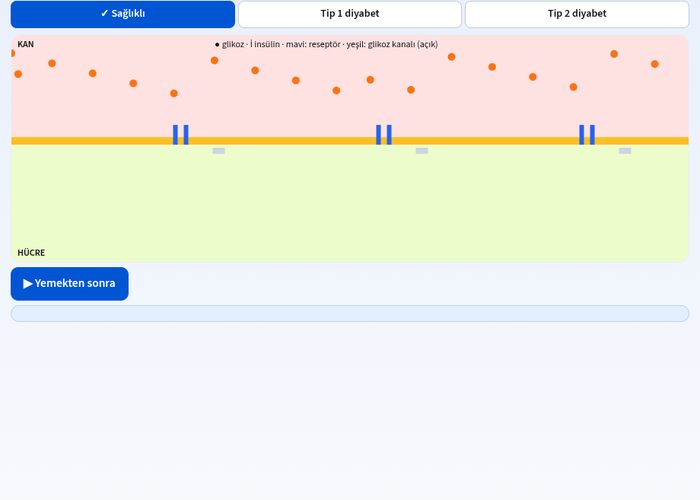
You can examine the conditions where body balance is disrupted at the cellular level with the Conditions Where Homeostasis Cannot Be Maintained simulation. In this interactive experiment, you will observe the mechanism of glucose entry into the cell by running the insulin-receptor-glucose channel model in healthy, type 1, and type 2 diabetic cells. At the same time, you will reinforce the concept of homeostasis by diagnosing different patient cases such as diabetes, hypertension, obesity, and thyroid based on data.
What can you do in this simulation?
You can observe the binding of insulin to the receptor and the opening of glucose channels in the healthy cell model.
You can simulate the Type 1 diabetes condition and examine the effect of insulin deficiency on glucose absorption.
You can run the Type 2 diabetes condition and test the unresponsiveness of the receptors.
You can correctly diagnose various patient cases (diabetes, hypertension, obesity, thyroid) by looking at the data.
You can reinforce your knowledge and receive feedback through card matching and question steps.
Basic concepts and formulas
Homeostasis is the ability of living organisms to maintain their internal balance within a stable and constant limit. The hormone insulin is secreted by the pancreas, binds to specific receptors on the cell surface, and triggers glucose channels (GLUT) to move to the cell membrane. This allows glucose present in the blood to enter the cell. In type 1 diabetes, insulin production is insufficient; in type 2 diabetes, although insulin is produced, the receptors on the cell membrane cannot respond to this alarm. In both cases, glucose accumulates in the blood, disrupting homeostasis.
How to use?
Go to the experiment panel and start examining the cellular model.
Observe the interaction of glucose and insulin by running healthy, type 1, and type 2 diabetes conditions respectively.
Carefully examine the patient data in the cases section.
Place the cards into the correct diagnostic boxes by dragging and dropping or by tapping.
Test your answers using the check button and complete your missing parts with the guidance of the mentor.
Frequently asked questions
How does glucose enter the cell in a healthy cell?
The insulin hormone binds to specific receptors on the cell membrane, enabling glucose channels to open and glucose to be transported from the blood into the cell.
What is the main difference between Type 1 and Type 2 diabetes?
In Type 1 diabetes, the body cannot produce enough insulin, whereas in Type 2 diabetes, insulin is produced but the receptors in the cells have become insensitive to insulin.
How does the disruption of homeostasis affect health?
Failure to maintain internal balance (homeostasis) hinders energy production in cells and leads to metabolic diseases such as diabetes, hypertension, or obesity.
 Interactive experiment