Liquids: experiments on boiling and external pressure, equilibrium vapor pressure, viscosity (falling ball; liquid type and temperature), surface tension (drop counting; liquid type, temperature, detergent)
Discover critical topics in chemistry class interactively with the liquids and their properties simulation. This digital experiment tool allows you to reinforce the concepts of boiling and external pressure relationship, vapor pressure, viscosity, and surface tension. By examining different liquids such as ethyl alcohol, acetone, and water, you can observe the effects of temperature, detergent, and pressure changes on liquid behavior.
What can you do in this simulation?
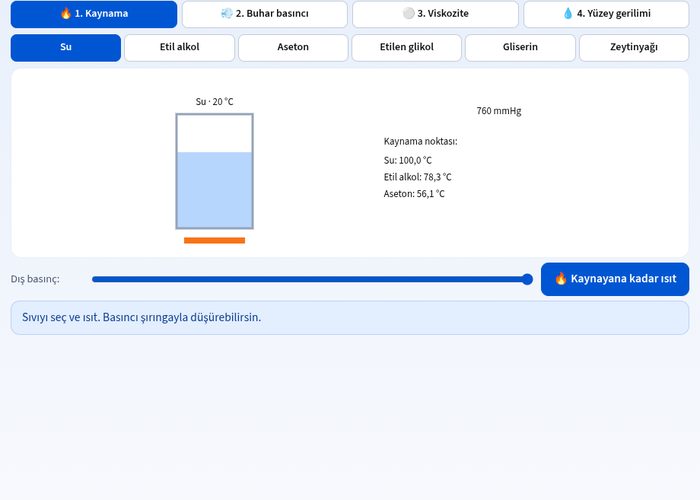
- You can boil different liquids at the boiling station using water, ethyl alcohol, and acetone.
- You can observe the change in the boiling point of water under low pressure and examine the vapor pressure curve.
- You can test different liquid types and the effect of temperature by performing viscosity experiments using the ball-drop method.
- You can make surface tension measurements using the drop-counting method and see the effects of temperature and detergent addition.
- You can instantly reinforce what you have learned with guided questions and interactive test cards.
Basic concepts and formulas
The properties of liquids depend on intermolecular forces of attraction. Boiling occurs at the temperature where the vapor pressure of the liquid equals the external pressure. Viscosity is the resistance to flow (eta) and is inversely proportional to temperature. Surface tension (gamma), on the other hand, is caused by the net inward force exerted by molecules on the liquid surface and can be reduced by adding detergent.
How to use?
- Open the simulation screen and select one of the boiling, viscosity, or surface tension stations.
- Adjust parameters such as liquid type, temperature, or pressure using the control panel.
- Start the experiment to take measurements and observe the results.
- Test your theoretical knowledge with practice by answering the guided questions.
Frequently asked questions
How is the boiling point of liquids affected by external pressure?
As the external pressure increases, a higher temperature is required for the vapor pressure of the liquid to equal the external pressure, which raises the boiling point.
How does viscosity change with temperature?
As the temperature increases, the kinetic energy of the molecules increases and intermolecular attraction weakens; thus, viscosity (resistance to flow) decreases.
Why does detergent lower surface tension?
Detergent molecules weaken the hydrogen bonds on the water surface, reducing the attractive force between liquid molecules and lowering surface tension.
 Interactive experiment