Intermolecular interactions: select two particles, find the interaction between them (London, dipole-dipol, hydrogen bond, ion-dipole, induced dipoles); boiling point graphs of halides and alkanes
Discover weak interactions between chemical species with the intermolecular forces simulation and examine the boiling point graphs of halides and alkanes. Thanks to this interactive experiment, you can reinforce core concepts such as London forces, dipole-dipole, and hydrogen bonding. It is a great resource to fill your gaps in chemistry class.
What can you do in this simulation?
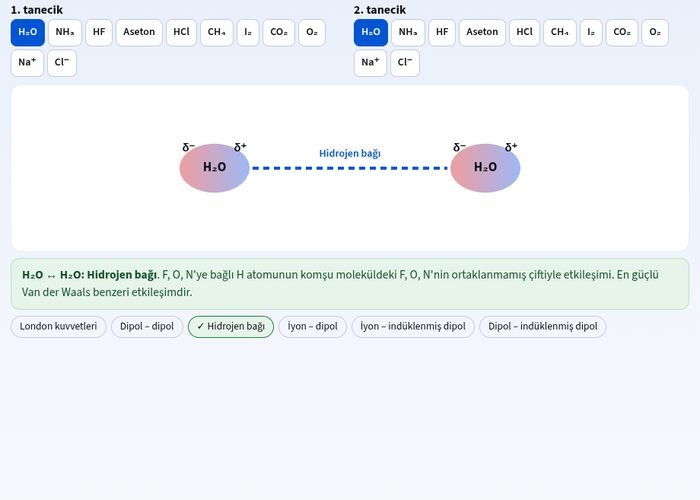
You can examine London forces, dipole-dipole, hydrogen bonding, ion-dipole, ion-induced dipole, and dipole-induced dipole interaction types.
You can match interaction types by dragging and dropping the given cards into the correct boxes.
You can analyze the boiling point graphs of hydrogen halides and 6A group hydrides.
You can observe the extraordinary boiling point properties and molecular structure of water molecules.
Basic concepts and formulas
Intermolecular forces determine physical properties such as melting and boiling points of substances. Hydrogen bonding is a strong type of interaction formed by hydrogen atoms bonded to F, O, N elements with unshared electron pairs on other molecules. London forces, on the other hand, are the attraction of temporary dipoles formed between nonpolar molecules and noble gases due to instantaneous symmetry breaking of electrons.
How to use?
Go to the experiment panel, read the guide, and examine the cards that appear.
Place a card into the relevant interaction box by tapping or dragging and dropping it.
Test the correctness of your answer by clicking the check your guess button.
Switch to the boiling point graphs tab to examine the graphs of hydride series.
Frequently asked questions
Why is the hydrogen bond the strongest weak interaction?
Because the electronegativity of F, O, and N elements is very high, polar bonds create a strong dipole, which increases intermolecular attraction.
In which substances are London forces observed?
London forces are observed in nonpolar molecules and all atomic noble gases as a result of instantaneous fluctuations of the electron cloud.
Why do water molecules have a high boiling point?
Since water molecules form dense hydrogen bonds among themselves, separating their molecules from each other requires more energy.
 Interactive experiment