Solids: heat crystalline (naphthalene) and amorphous (candle) solids, compare sharp melting point with slow softening on the heating curve; ionic, covalent, molecular, and metallic crystals
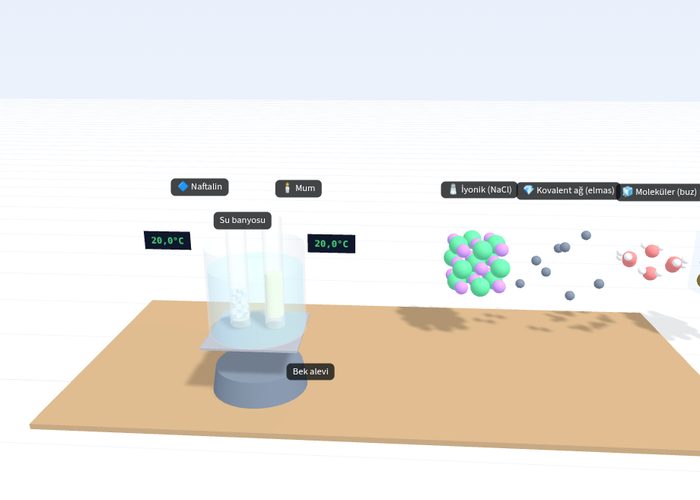
You can interactively examine the behaviors of crystalline and amorphous solids in chemistry class with the solids and their properties simulation. In this experiment, you will observe heating curves by heating substances such as naphthalene and candle, and you will learn the differences between a sharp melting point and slow softening. Additionally, you will find the opportunity to practice by placing different substances such as table salt, diamond, ice, and copper into the correct boxes according to their crystal types.
What can you do in this simulation?
You can plot the temperature-time change graph by heating substances such as naphthalene and candle for 20 minutes.
You can compare the heating characteristics of crystalline and amorphous solids by following the blue and yellow curves.
You can examine examples such as table salt (NaCl), calcium fluoride (CaF₂), diamond (C), and quartz (SiO₂).
You can match substances like ice, iodine, sugar, copper, and iron with ionic, covalent, molecular, or metallic crystal types.
By progressing step by step with the guide, you can test your predictions with experimental results and get instant feedback.
Basic concepts and formulas
Solids are generally divided into two categories: crystalline and amorphous. Crystalline solids have a definite geometric shape and a sharp melting point (for example, naphthalene melting at 80 °C). Amorphous solids, on the other hand, do not have a definite melting point; as they are heated, they slowly soften within a specific temperature range (glass, candle, plastic). Crystal types are classified among themselves as ionic, covalent, molecular, and metallic.
How to use?
Open the experiment screen, start the naphthalene and candle heating step, and watch the temperature-time graph form.
When the heating curves are complete, examine the melting and softening differences shown by the blue and yellow graphs.
Examine the substances given on the cards and think about which crystal type they belong to.
Place the substances into the correct categories by touching and dragging the cards or by clicking the appropriate columns.
Verify your answers using the check button and complete your missing parts with the help of the guide.
Frequently asked questions
What is the main difference between crystalline and amorphous solids?
Crystalline solids melt at a fixed and sharp melting temperature because they have an ordered structure. Amorphous solids, on the other hand, have a disordered structure and slowly soften when heated without exhibiting a specific melting point.
Naphthalene is an example of which type of solid?
Naphthalene is a molecular crystalline solid that has a specific melting point (80 °C).
What are the properties of ionic crystals?
Ionic crystals are formed by the mutual attraction of positive and negative charges; they are generally hard and brittle, and while they do not conduct electricity in the solid state, their aqueous solutions conduct electricity.
 Interactive experiment