Theme 2: Diversity
grade 9 chemistry · theme 2
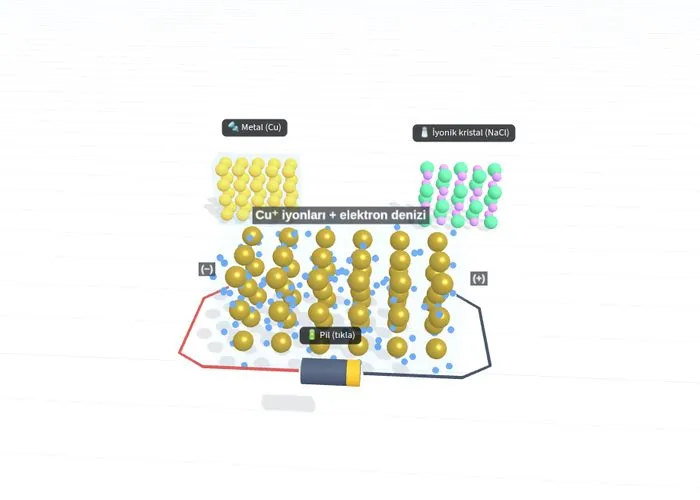
2.1.1 Metallic Bond
Metallic bond: electron sea model; flow of free electrons upon applying voltage (conductivity), sliding of layers when struck with a hammer (malleability), and comparison with the fracture of ionic crystals
Open Simulation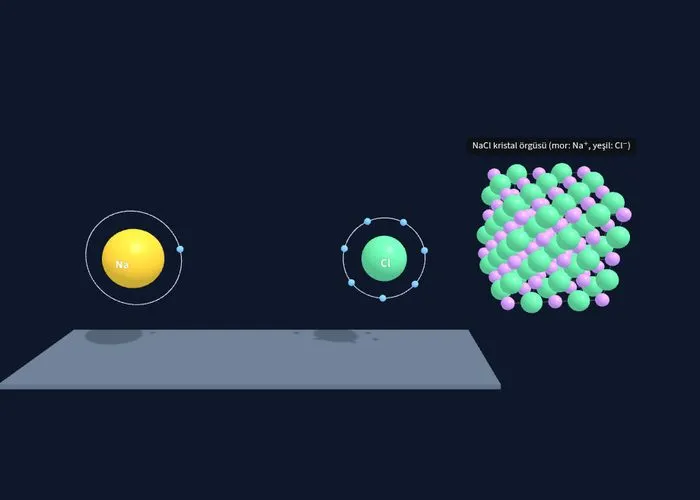
2.1.2 Ionic Bond
Ionic bond: select metal and nonmetal, perform electron transfer, balance charges to find the formula (NaCl, MgCl₂, Al₂O₃, CaF₂, K₂S); NaCl crystal lattice
Open Simulation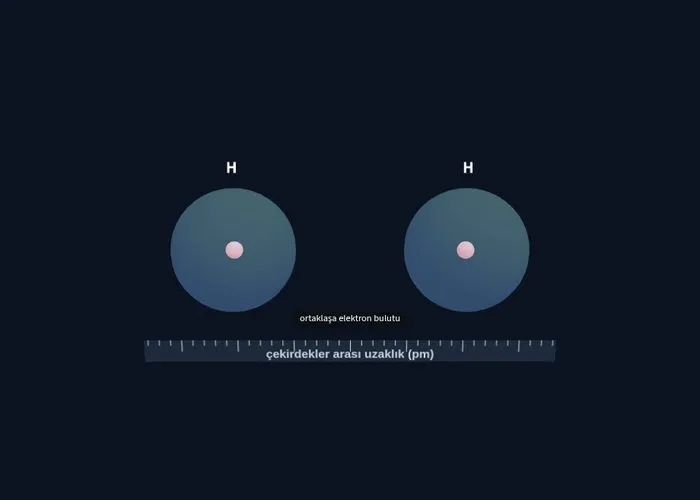
2.1.3 Covalent Bond
Covalent bond: bring two hydrogen atoms closer and draw the potential energy curve (bond length 74 pm, bond energy 436 kJ/mol); distinguish between ionic, polar, and nonpolar bonds using electronegativity difference
Open Simulation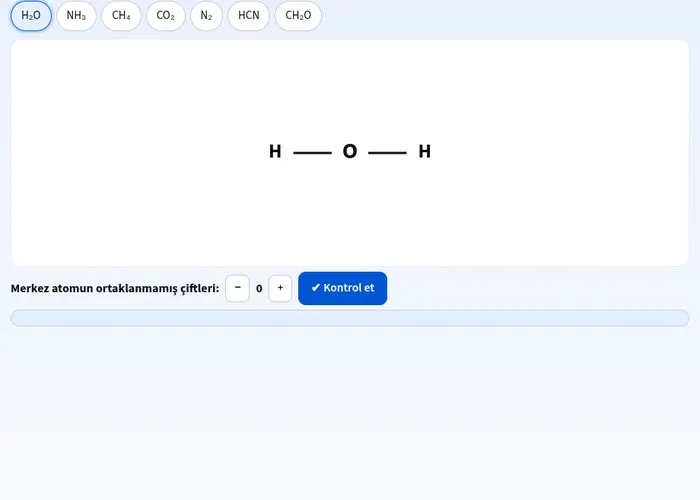
2.1.4 Lewis Dot Structure
Lewis structure builder: count valence electrons, set bond order (single/double/triple) and unshared pairs of the central atom; octet and electron count are instantly verified
Open Simulation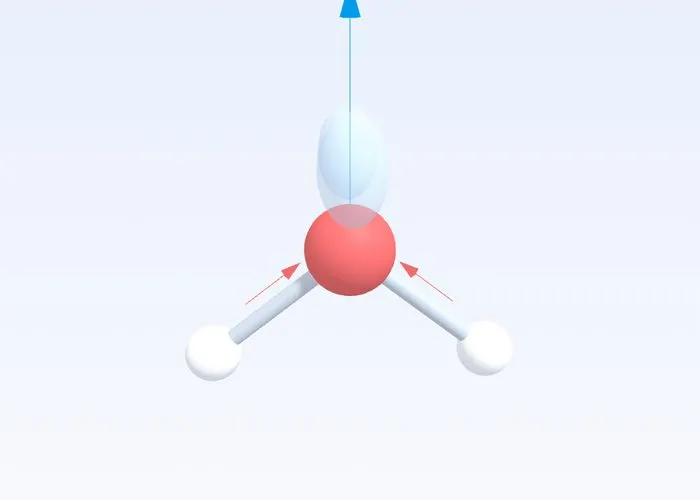
2.1.5 Molecular Polarity and Nonpolarity
3B molecules: H₂O, NH₃, CH₄, CO₂, BF₃, HCl, CCl₄, CHCl₃; view bond dipoles and net dipole moment, determine polar–apolar nature based on molecular geometry
Open Simulation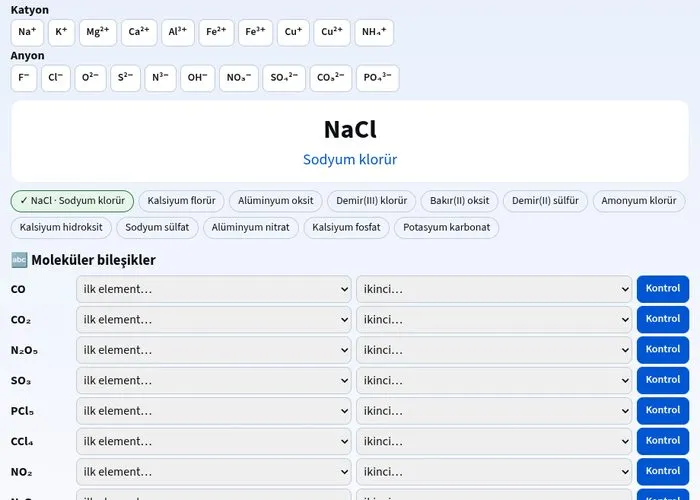
2.1.6 Naming of Compounds
Compound naming workshop: ionic compounds (metals with variable oxidation states, polyatomic ions) and molecular compounds (mono-, di-, tri- prefixes); from formula to name, from name to formula
Open Simulation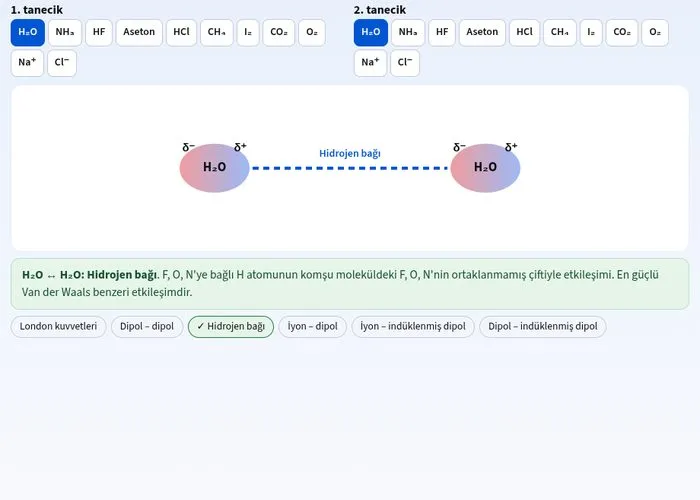
2.2.1 Intermolecular Forces
Intermolecular interactions: select two particles, find the interaction between them (London, dipole-dipol, hydrogen bond, ion-dipole, induced dipoles); boiling point graphs of halides and alkanes
Open Simulation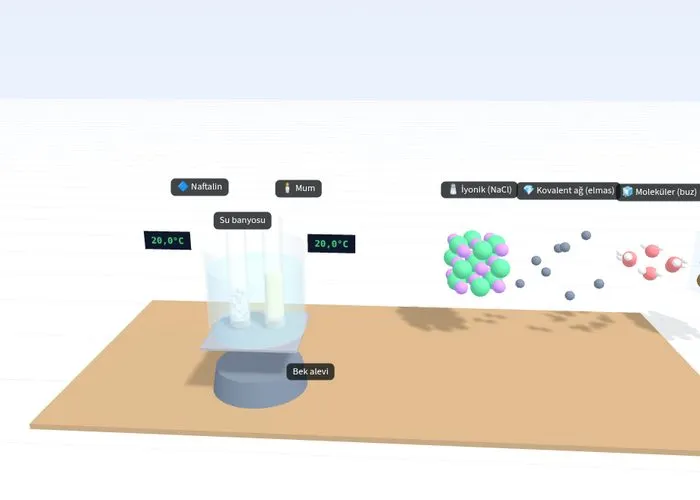
2.2.2 Solids and Their Properties
Solids: heat crystalline (naphthalene) and amorphous (candle) solids, compare sharp melting point with slow softening on the heating curve; ionic, covalent, molecular, and metallic crystals
Open Simulation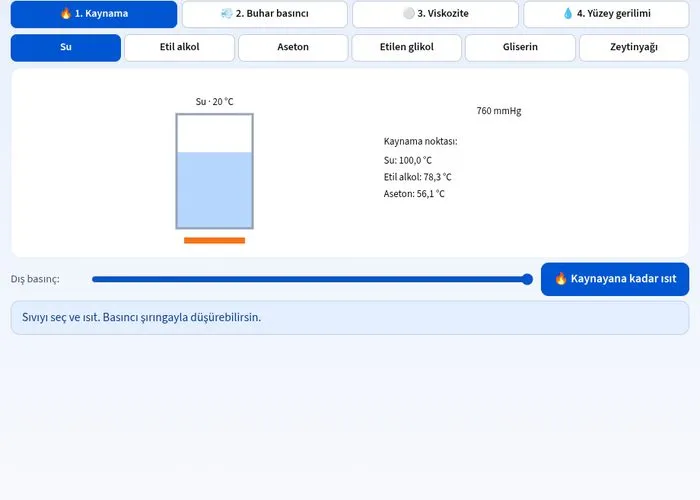
2.2.3 Liquids and Their Properties
Liquids: experiments on boiling and external pressure, equilibrium vapor pressure, viscosity (falling ball; liquid type and temperature), surface tension (drop counting; liquid type, temperature, detergent)
Open Simulation