Compound naming workshop: ionic compounds (metals with variable oxidation states, polyatomic ions) and molecular compounds (mono-, di-, tri- prefixes); from formula to name, from name to formula
With the naming of compounds simulation, you can interactively learn the rules for ionic and molecular compounds, and practice from formula to name and name to formula. This chemistry workshop aims to reinforce, in particular, variable-valence metals, polyatomic ions, and the mono-, di-, tri- prefixes in covalent compounds.
What can you do in this simulation?
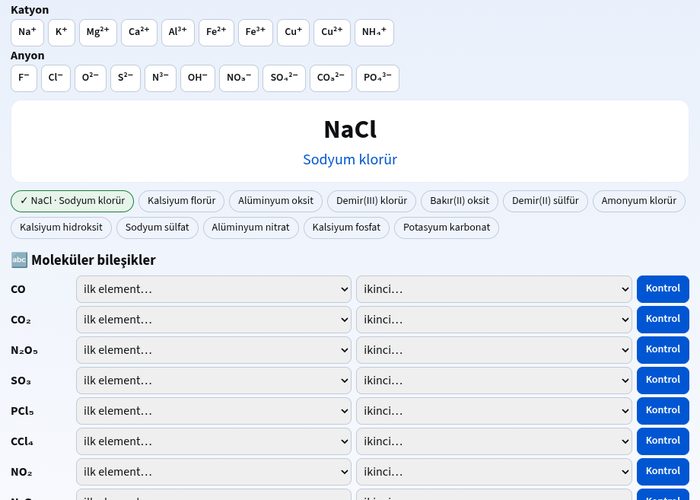
You can create ionic compounds by selecting cations and anions and examine their correct naming.
You can learn the valences of variable-valence metals (copper, iron, etc.) represented in Roman numerals.
You can completely finish 12 ionic and 8 molecular compounds in accordance with the targets on the task cards.
You can solve matching tasks by dragging and dropping cards into the relevant boxes or by tapping them.
Thanks to the instant feedback system, you can see your mistakes and do repetitions.
Basic concepts and formulas
Chemical compounds form when elements come together in specific proportions. When naming ionic compounds, the name of the cation (metal or polyatomic ion) is stated first, followed by the name of the anion (nonmetal or polyatomic ion). For example, the compound NaCl is read as sodium chloride. For those containing variable-valence metals (such as copper(I) oxide and copper(II) oxide), the oxidation state of the metal is indicated in parentheses. In covalently bonded molecular compounds, atom numbers are expressed with Latin prefixes (mono-, di-, tri-, tetra-), for example, carbon dioxide (CO2).
How to use?
Go to the experiment panel and select ionic or molecular compound tasks.
Examine the task cards appearing on the screen and determine the requested compound.
Place the cation and anion cards into the correct boxes by tapping or dragging and dropping them.
Test the accuracy of your answer by pressing the "Check" button and try to get correct results on the first attempt.
When all tasks are finished, return to the guide and review your mistakes.
Frequently asked questions
Why do we write the valence of the metal in parentheses when naming ionic compounds?
Some transition metals can take on more than one positive charge (valence). For example, since copper can take both +1 and +2 charges, the compound Cu2O is named copper(I) oxide, and the compound CuO is named copper(II) oxide.
Is the mono- prefix always used in molecular compounds?
The mono- prefix is generally not used for the first element; it is emphasized only in cases where the second element (like oxygen) is present in more than one quantity or in special exceptions like carbon monoxide.
Which chemistry topics can I reinforce in this simulation?
You can reinforce the rules of naming ionic and covalent compounds, formula-writing skills, and polyatomic ion compounds included in Theme 2 Diversity within the class chemistry curriculum.
 Interactive experiment