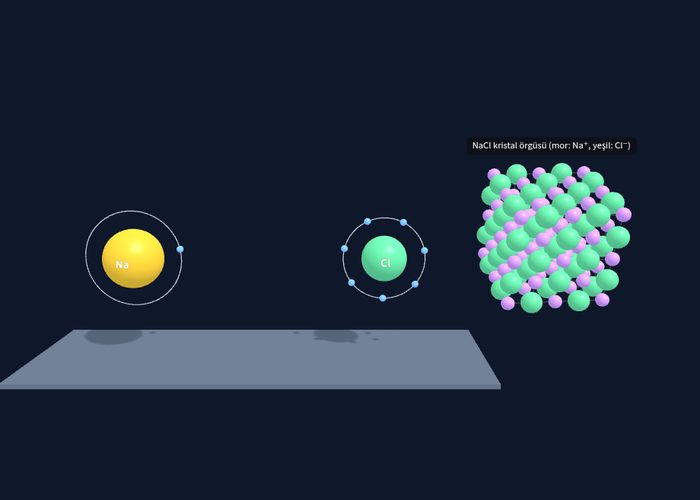
Ionic bond: select metal and nonmetal, perform electron transfer, balance charges to find the formula (NaCl, MgCl₂, Al₂O₃, CaF₂, K₂S); NaCl crystal lattice
With the ionic bond simulation, you can interactively examine the electron exchange between metal and nonmetal atoms, and easily discover the formulas of basic ionic compounds such as NaCl, MgCl2, Al2O3, CaF2, and K2S by establishing charge balance. Suitable for the 9th grade chemistry curriculum, this tool helps you understand the formation mechanism of ionic compounds and the logic of crystal lattice structure.
What can you do in this simulation?
You can design ionic bond experiments by selecting metal and nonmetal atoms.
You can zero out the sum of charges by adding atoms and transferring electrons.
You can individually create all 5 different ionic compounds, namely NaCl, MgCl2, Al2O3, CaF2, and K2S.
You can instantly check the number of transferred electrons and the charge balance.
You can reach the correct formulas by proceeding step by step with the guidance.
Basic concepts and formulas
An ionic bond relies on the electrostatic attraction force between a metal that donates electrons (cation, positively (+) charged) and a nonmetal that accepts electrons (anion, negatively (-) charged). When a compound forms, the total net charge must be zero; for example, for Magnesium Chloride with the formula MgCl2, 2 Cl(-1) ion(s) are required for 1 Mg(+2) ion.
How to use?
Go to the experiment panel and select the metal and nonmetal atoms.
Add atoms and initiate electron transfer.
Place the cards by tapping the relevant boxes or by dragging and dropping them.
Form the compound by checking the zeroing of the total charge and the ratios.
When all compounds are completed, return to the guide and review your results.
Frequently asked questions
How is an ionic bond formed?
A metal atom donates electrons to form a positive cation, while a nonmetal atom accepts electrons to form a negative anion, and these two opposite charges attract each other.
Why must the total charge be zero?
For the resulting ionic compounds to be stable and neutral, the total number of electrons gained must equal the total number of electrons lost.
Which compounds can I form?
You can learn by experimenting with five basic ionic compounds having the formulas NaCl, MgCl2, Al2O3, CaF2, and K2S in the simulation.
 Interactive experiment