Covalent bond: bring two hydrogen atoms closer and draw the potential energy curve (bond length 74 pm, bond energy 436 kJ/mol); distinguish between ionic, polar, and nonpolar bonds using electronegativity difference
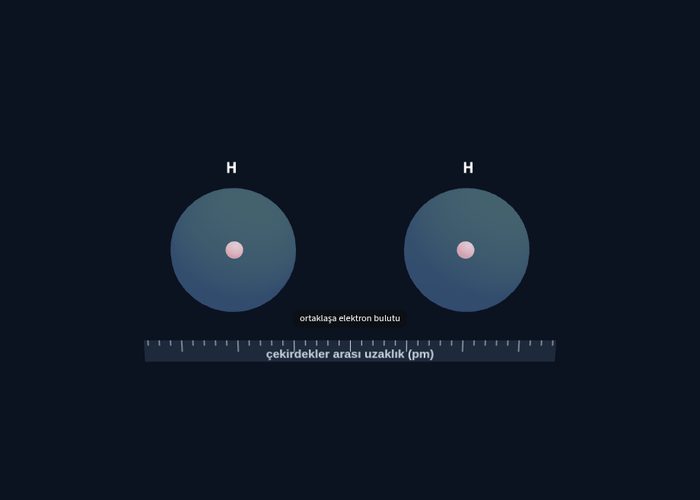
With the covalent bond simulation, you can examine the approach of two hydrogen atoms, derive the potential energy curve, and learn the concepts of bond length and bond energy. This interactive experiment allows you to discover the relationship between interatomic distance and energy, and to distinguish bond types based on electronegativity difference. It is a great resource to reinforce the topic of interactions between chemical species in chemistry class.
What can you do in this simulation?
You can plot the potential energy curve by bringing the hydrogen atoms closer together.
You can find the ideal bond length by scanning the distance and bringing it into the 70-78 pm range.
You can examine single, double, and triple bond types and correctly select the bond type for atom pairs.
You can learn with a guide and answer questions by dragging and dropping cards into the appropriate boxes.
Basic concepts and formulas
A covalent bond is formed by the sharing of electrons between nonmetal atoms. When two atoms approach each other, attractive and repulsive forces balance out; this equilibrium point corresponds to the lowest potential energy and the stable bond length (approximately 74 pm for hydrogen). The electronegativity difference (ΔEN) determines whether the bond is polar or nonpolar.
How to use?
Open the experiment screen and follow the guide to examine the atom pairs.
Observe the change in the potential energy curve by scanning the distance setting over a wide range.
Determine the bond length by bringing the atoms into the 70-78 pm range.
Complete the bond types test by placing the cards into the relevant boxes and check your results.
Frequently asked questions
What happens if two atoms get too close to each other?
The nuclei repel each other, causing the potential energy to rise rapidly and the system to become unstable.
Where is the bond length found on the potential energy curve?
The lowest point of the curve, which is the distance where potential energy is at its minimum, gives the stable bond length.
How do covalent bonds differ from ionic bonds?
Covalent bonds are formed by the sharing of electrons, whereas ionic bonds are formed by the transfer of electrons.
 Interactive experiment