Metallic bond: electron sea model; flow of free electrons upon applying voltage (conductivity), sliding of layers when struck with a hammer (malleability), and comparison with the fracture of ionic crystals
Discover the electron sea model with the metallic bond simulation and interactively learn the fundamental physical properties of metals. In this experiment, you will examine the movement of free delocalized electrons and reinforce the concepts of electrical conductivity and malleability. Suitable for the 9-grade chemistry curriculum, this material enables you to understand the structure of metals.
What can you do in this simulation?
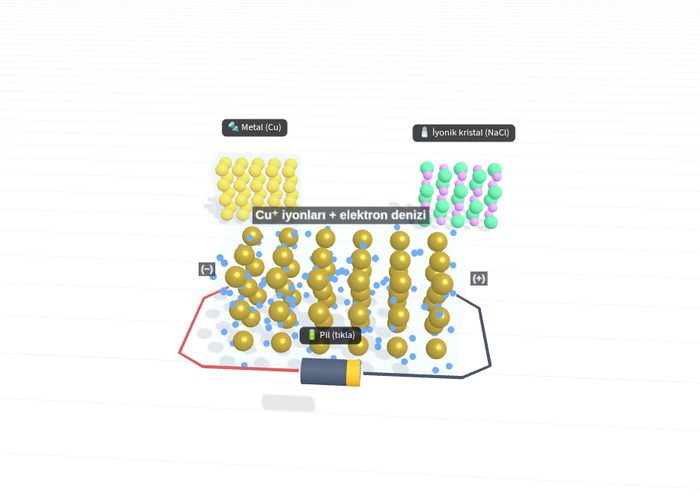
You can examine the electron sea model to observe atomic cores and free delocalized electrons.
You can test electrical conductivity by turning on the voltage and observing the electron flow.
You can see the difference between layer shifting and brittleness by striking the metal and the ionic crystal with a hammer.
You can reinforce how the strengthening of the metallic bond occurs with an increasing number of valence electrons through questions.
Basic concepts and formulas
A metallic bond is the electrostatic attraction force between positive metal ions and the mobile valence electrons surrounding these ions. The electron sea model explains the heat and electrical conductivity, luster, and workability of metals. As the number of valence electrons increases, the metallic bond strengthens and the melting point generally rises.
How to use?
Open the experiment screen and examine the steps accompanied by the guide.
Turn on the voltage on the model and observe the electron flow.
Strike the metal using the hammer tool and test the shifting of layers.
Compare your predictions with the experiment results by answering the questions.
Frequently asked questions
What is the electron sea model?
It is the chemical bonding model where positive metal ions are situated within a freely moving delocalized electron cloud.
Why do metals conduct electric current?
Free delocalized electrons move in one direction when an external voltage is applied, carrying the electric current.
Why does a metal not break when struck by a hammer?
The electron sea flexibly compensates for shifts, and while positive ion layers repel each other, the bonds do not break, they only change shape.
 Interactive experiment