3B molecules: H₂O, NH₃, CH₄, CO₂, BF₃, HCl, CCl₄, CHCl₃; view bond dipoles and net dipole moment, determine polar–apolar nature based on molecular geometry
If you want to reinforce the topic of molecular polarity and nonpolarity in your chemistry class, this interactive molecular polarity simulation is just for you. You can observe bond dipoles and the net dipole moment by examining the structures of basic 3 molecules such as H2O, NH3, CH4, CO2, BF3, HCl, CCl4, and CHCl3. While discovering whether substances have a polar or nonpolar structure based on molecular shape, you can make up for your shortcomings regarding chemical bonds.
What can you do in this simulation?
You can examine the three-dimensional models of H2O, NH3, CH4, CO2, BF3, HCl, CCl4, and CHCl3 molecules.
You can interpret the properties of compounds by visualizing bond dipoles and the net dipole moment.
You can explore different molecular geometries such as linear, angular, trigonal planar, trigonal pyramidal, and tetrahedral.
You can decide whether molecules are polar or nonpolar by dragging and dropping the cards into the appropriate boxes.
You can test your learning by checking your guesses and receiving instant feedback.
Basic concepts and formulas
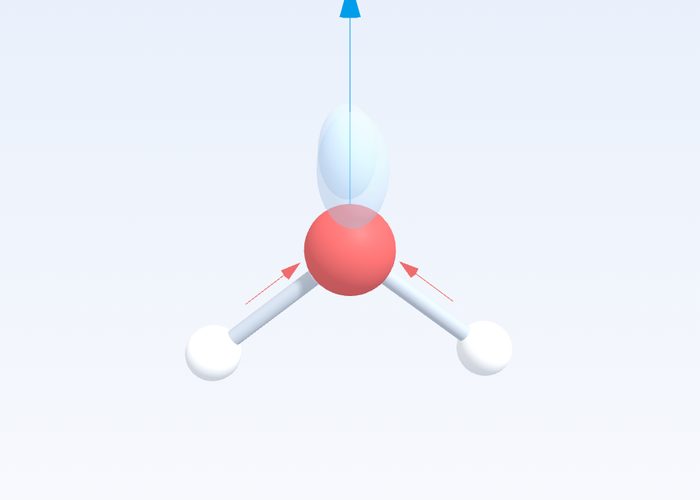
In chemistry, whether a molecule is polar or nonpolar depends on the unshared electron pairs on the central atom and the molecular geometry. Bond dipoles formed due to electronegativity differences are added vectorially; if the net dipole moment is different from zero (μ ≠ 0), the molecule is polar, and if it is zero (μ = 0), it is nonpolar.
How to use?
Open the experiment screen and start examining 3B molecular models.
Observe the shape of the molecule, bond dipoles, and the net dipole moment.
Place the cards by tapping the relevant boxes or by dragging and dropping them.
Test the correctness of your guess by clicking the check your answer button.
Review your shortcomings with the help of the guide and repeat the experiment.
Frequently asked questions
How do you determine whether a molecule is polar?
First, the symmetry of the central atom and the lone electron pairs on it are examined. If the sum of the vector bond dipoles is zero, the molecule is nonpolar; if it is different from zero, it is polar.
Why is water (H2O) polar?
The water molecule has an angular (bent) geometry, and the lone electrons on the oxygen atom disrupt the symmetry, causing the net dipole moment to be different from zero.
Why are CH4 and CCl4 molecules nonpolar?
These molecules have a tetrahedral symmetrical geometry, and the bond dipoles completely balance each other out, so the net dipole moment is zero.
 Interactive experiment