Coligative properties: measure boiling point elevation and freezing point depression by adding salt and sugar to water; ΔT = K·m·i; salting roads and antifreeze
Explore properties such as boiling point elevation and freezing point depression of solutions with the colligative properties simulation. In this interactive experiment, you can observe temperature changes of solutions by adding salt, sugar, and calcium chloride (CaCl₂) to water, and learn their applications in daily life. Prepared for high school and university chemistry classes, this tool helps you reinforce theoretical knowledge.
What can you do in this simulation?
You can prepare 1 molal solutions with three different solute substances.
You can measure the effects of sugar (C₁₂H₂₂O₁₁) and other substances on freezing point depression.
You can examine how much salts like CaCl₂ and similar ones lower the freezing point.
You can test the logic of salting roads and using antifreeze with interactive questions.
You can compare your predictions with experiment results by proceeding step by step with a guide.
Basic concepts and formulas
Properties that depend on the concentration of solute particles are called colligative properties. Freezing point depression and boiling point elevation are examined under this scope. The basic formula is as follows: ΔT = K · m · i (Here, ΔT represents the temperature change, K the molal constant, m the molality, and i the number of ions).
How to use?
Open the experiment panel and read the given instructions along with the guide.
Prepare 1 molal solutions by selecting different solute substances.
Observe temperature changes and freezing point differences using measuring tools.
Check your predictions by placing the cards and questions into the appropriate boxes.
Try different scenarios again by pressing the restart button.
Frequently asked questions
What do colligative properties include?
Colligative properties include vapor pressure lowering, boiling point elevation, freezing point depression, and osmotic pressure phenomena.
Why is salt salted on roads?
When salt is spread on roads in winter, the freezing point of water drops, thus preventing icing or melting the formed ice.
How does the number of ions affect the freezing point?
As the number of ions given to the solution (the i factor) increases, the amount of freezing point depression increases at the same rate.
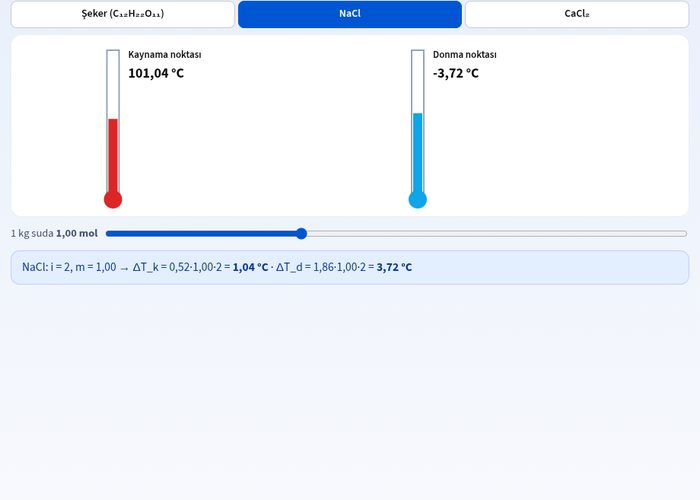 Interactive experiment