Theme 2: Diversity
grade 10 chemistry · theme 2
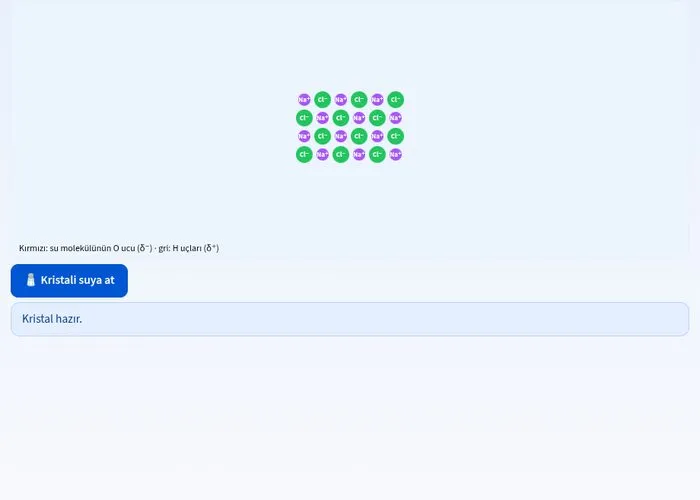
2.1.1 Dissolution Process
Dissolution process: observe the dissolution of NaCl in water at the particle level (hydration); measure the temperature change during the dissolution of ammonium nitrate (cold pack) and calcium chloride (hot pack)
Open Simulation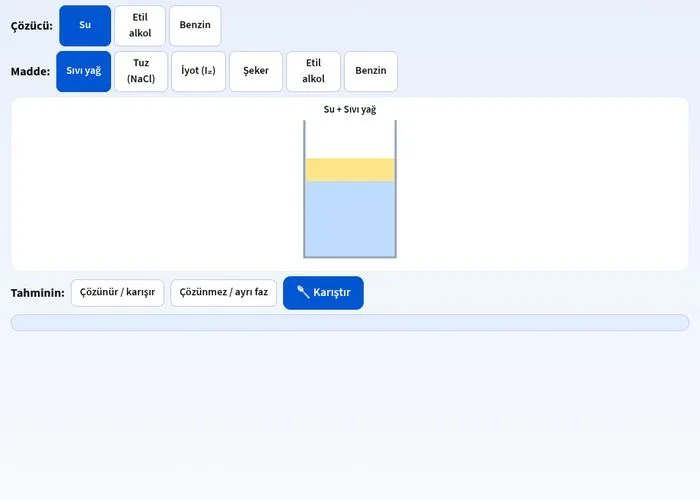
2.1.2 Mutual Solubility of Substances
Like dissolves like: mix water, ethyl alcohol, cooking oil, gasoline, salt, iodine, and sugar in pairs; predict and observe whether they dissolve or form separate phases based on polar–nonpolar interactions
Open Simulation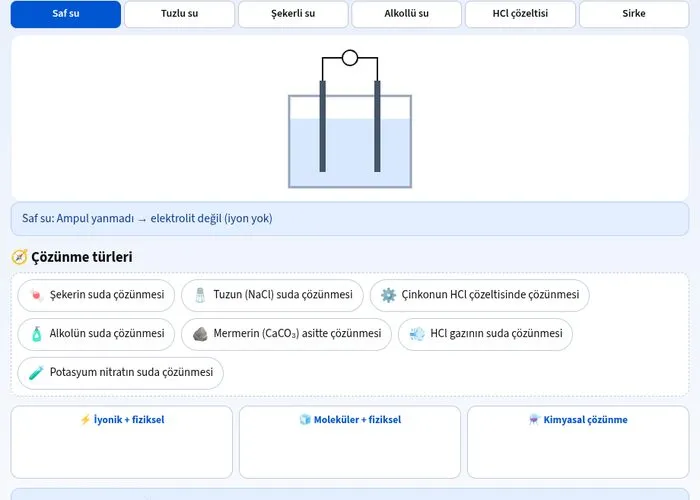
2.1.3 Classification of the Dissolution Process
Classification of the dissolution process: ionic and molecular dissolution, physical and chemical dissolution; distinguish ionic dissolution with a conductivity test, classify examples
Open Simulation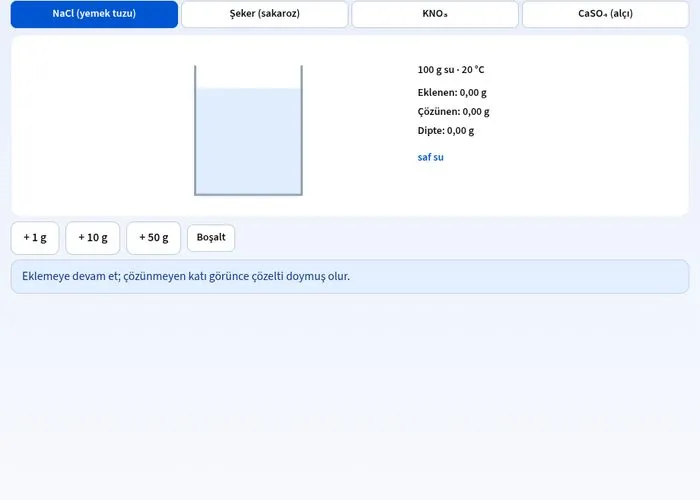
2.1.4 Solubility
Solubility: reach saturation by adding salt and sugar spoonful by spoonful to 100 g of water; unsaturated, saturated, and supersaturated solutions; solubility values at 20 °C
Open Simulation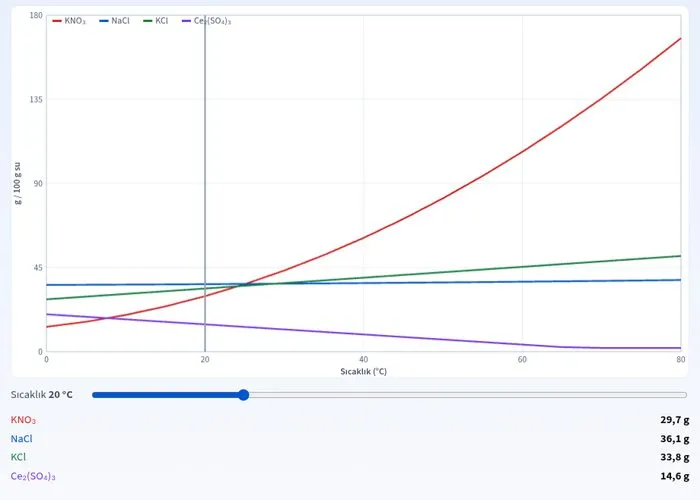
2.1.5 Factors Affecting Solubility
Factors affecting solubility: KNO₃, NaCl, KCl, and Ce₂(SO₄)₃ solubility–temperature curves; dissolving by heating, crystallization by cooling; variation of gas solubility with temperature and pressure (soda)
Open Simulation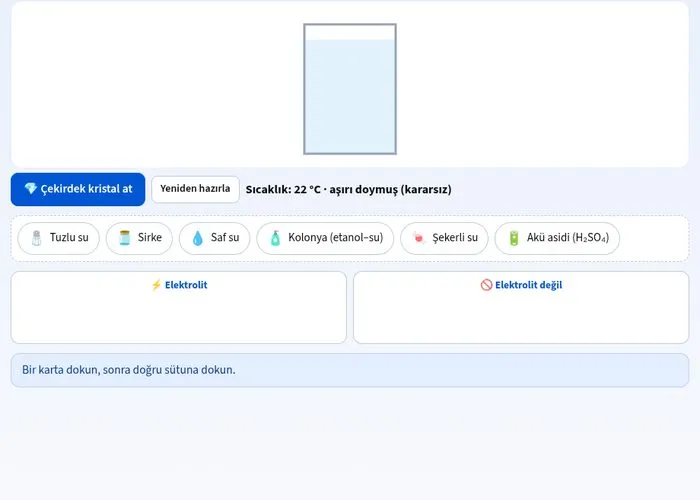
2.1.6 Classification of Solutions
Classification of solutions: electrolyte–nonelectrolyte, concentrated–dilute, unsaturated–saturated–supersaturated; instant crystallization of a supersaturated solution with sodium acetate
Open Simulation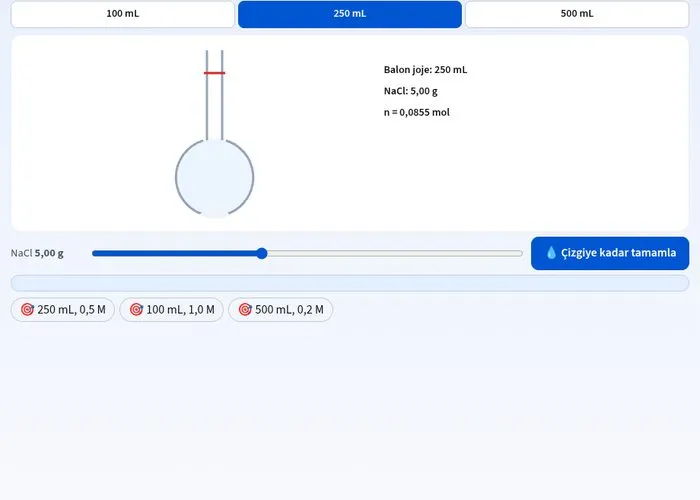
2.1.7 Concentration Units (Molarity, ppm)
Concentration units: weigh NaCl and make up to volume in a volumetric flask to prepare a solution of desired molarity; dilution M₁V₁ = M₂V₂; ppm for ions in drinking water
Open Simulation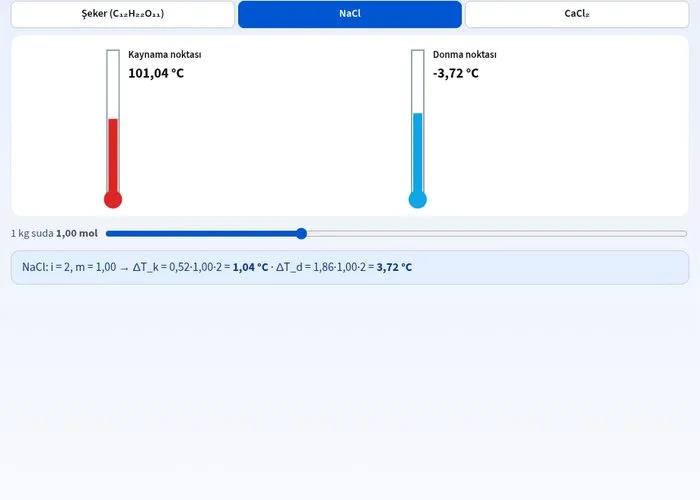
2.1.8 Coligative Properties
Coligative properties: measure boiling point elevation and freezing point depression by adding salt and sugar to water; ΔT = K·m·i; salting roads and antifreeze
Open Simulation