Solubility: reach saturation by adding salt and sugar spoonful by spoonful to 100 g of water; unsaturated, saturated, and supersaturated solutions; solubility values at 20 °C
Interactively discover unsaturated, saturated, and supersaturated solution states by adding spoonfuls of salt and sugar to 100 grams of pure water with the solubility simulation. Aligned with the Grade 10 chemistry diversity unit, in this experiment you will examine solubility values at 20 degrees and observe dissolution limits and solid accumulation at the bottom.
What can you do in this simulation?
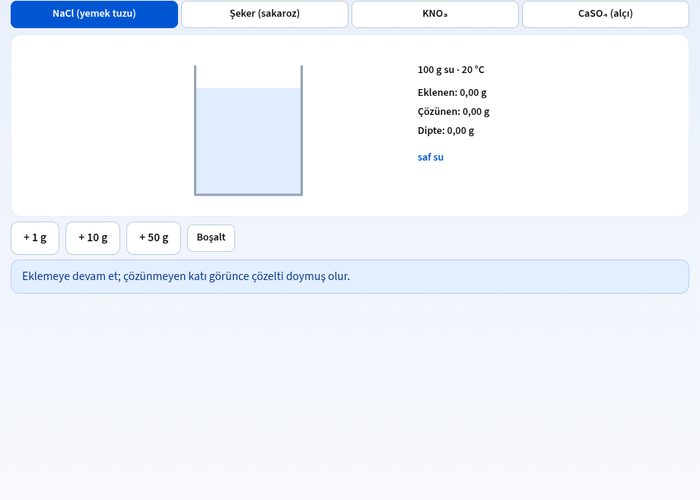
You can prepare solutions by adding NaCl (table salt), sugar (sucrose), or CaSO₄ (gypsum) to 100 grams of pure water.
You can add substances spoonful by spoonful and follow transitions between unsaturated, exactly saturated, and saturated (with solid at the bottom) states.
You can compare the solubility of substances in water by preparing saturated solutions with at least 3 different substances.
You can record your predictions, test them against experimental results, and advance step-by-step with the guide.
You can increase your score by answering correctly and use hints whenever you get stuck.
Basic concepts and formulas
Solubility represents the maximum amount of solute, in grams, that can dissolve in 100 grams of solvent (usually water) at a given temperature. Solution types are classified based on this limit as unsaturated, saturated, and supersaturated. The solubility relation is generally expressed as S = (Amount of Solute / Amount of Solvent) · 100 and varies from substance to substance with changes in temperature.
How to use?
Open the experiment panel and select the substance (salt, sugar, or gypsum) you want to add to pure water.
Add the substance slowly to water using the spoon buttons and observe the amount dissolved.
Observe whether the solution becomes unsaturated, fully saturated, or saturated with solid left at the bottom.
Answer the questions, check your predictions, and advance through the guided steps.
Click the restart button to repeat the experiment with different substances and compare the results.
Frequently asked questions
Where do added substances accumulate when a solution reaches saturation?
Once a solution exceeds its exact saturation point, excess added substance cannot dissolve and precipitates as a solid at the bottom of the container.
How does temperature affect solubility values?
Generally, the solubility of solids in water increases with temperature, but each substance has its own unique solubility characteristics and maximum limit value.
What is the difference between an unsaturated solution and a saturated solution?
While an unsaturated solution contains less solute than it can dissolve at a given temperature, a saturated solution contains the exact maximum amount of solute it can hold.
 Interactive experiment