Concentration units: weigh NaCl and make up to volume in a volumetric flask to prepare a solution of desired molarity; dilution M₁V₁ = M₂V₂; ppm for ions in drinking water
You can interactively learn molarity and ppm calculations in chemistry class with the Concentration Units simulation. This experiment allows you to prepare solutions at desired concentrations in a laboratory setting by weighing NaCl and using a volumetric flask. It is a great resource to reinforce 10th-grade chemistry topics and grasp dilution processes.
What can you do in this simulation?
You can prepare 3 different target solutions with the correct steps.
You can weigh the amount of NaCl and make up the volume using a volumetric flask.
You can make dilution calculations using the formula M₁V₁ = M₂V₂.
You can examine the ion concentrations in drinking water in terms of ppm.
You can answer questions and test your knowledge with the help of a step-by-step guide.
Basic concepts and formulas
Molarity (M) is the number of moles of solute in one liter of solution and is calculated by the formula M = n / V. Here, n is the moles of the solute, and V is the volume of the solution in liters. ppm (parts per million) expresses the amount of solute in dilute solutions. For dilution processes, the equation M₁V₁ = M₂V₂ is used.
How to use?
Open the experiment panel and read the instructions in the guide.
Calculate the amount of substance required for the target solution and weigh NaCl.
Make up the volume of the solution using a volumetric flask.
Perform dilution and ppm calculations and check the results.
Frequently asked questions
How is molarity calculated?
Molarity is found by dividing the number of moles of the solute by the volume of the solution in liters.
What does ppm mean?
ppm stands for parts per million and is a concentration unit used in very dilute solutions.
What is the dilution formula?
The formula M₁V₁ = M₂V₂ is used to establish the relationship between concentration and volume in the initial and final states.
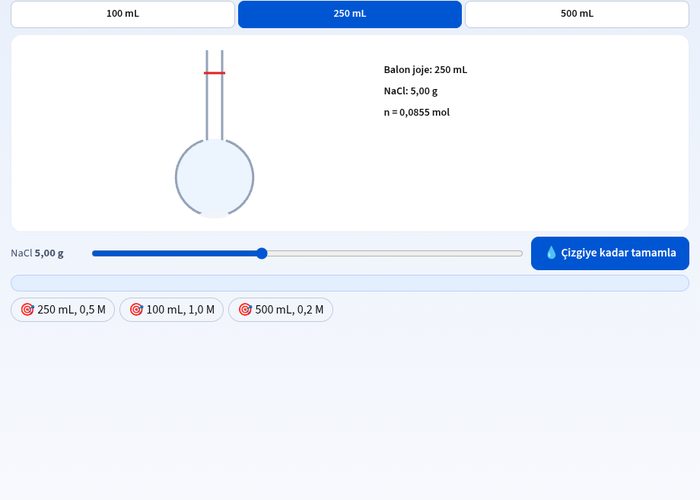 Interactive experiment