Like dissolves like: mix water, ethyl alcohol, cooking oil, gasoline, salt, iodine, and sugar in pairs; predict and observe whether they dissolve or form separate phases based on polar–nonpolar interactions
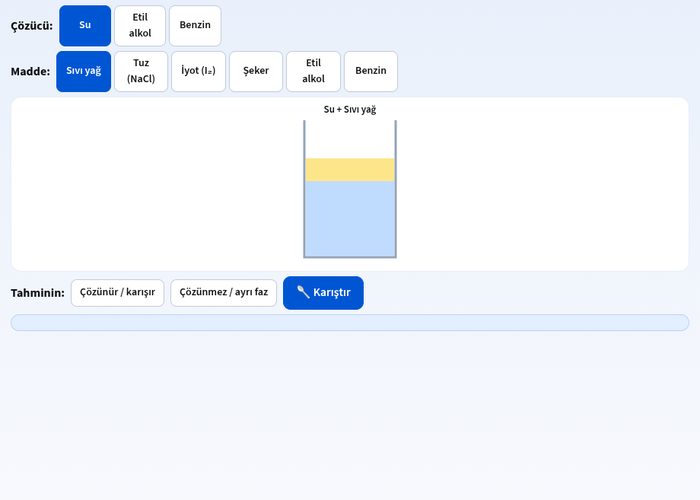
Interactively explore the rules of dissolution of polar and nonpolar molecules in each other in chemistry with the Solubility of Substances in Each Other simulation. You can test which substances dissolve in one another or form separate phases by matching different substances such as pure water, saltwater, sugary water, liquid oil, gasoline, and acetone. Reinforcing the principle of "like dissolves like", this experiment makes it easier for you to understand 10th-grade chemistry topics and improves your observation skills.
What can you do in this simulation?
You can examine different aqueous solutions such as pure water, saltwater, and sugary water.
You can select nonpolar and weakly polar solvents such as gasoline or acetone.
You can mix substances in pairs and predict the interactions between them.
You can record your predictions and instantly check the results via the experiment panel.
You can discover the rule by trying at least 6 different pairs and proceed with the guidance.
Basic concepts and formulas
In chemistry, the "like dissolves like" rule is a fundamental principle. Polar substances (e.g., water) dissolve well in polar solvents, while nonpolar substances dissolve well in nonpolar solvents (e.g., gasoline). Similarly, ionic compounds tend to dissolve in polar solvents while not dissolving in nonpolar environments. Dipole-dipole interactions, hydrogen bonds, and London forces form the basis of these solubility phenomena.
How to use?
Open the experiment panel and log in to the solubility of substances in each other simulation.
Determine the pairs by choosing among cards or substances.
Use the relevant buttons to save your prediction.
Check your correct or incorrect answers by observing the results.
Fully discover the rule by trying at least 6 pairs and benefit from the guide's hints.
Frequently asked questions
What does the 'like dissolves like' rule mean?
This rule states that polar substances dissolve in polar solvents, and nonpolar substances dissolve in nonpolar solvents.
Why do water and oil not dissolve in each other?
Water is a polar molecule while vegetable oil has a nonpolar structure; therefore, sufficiently strong interactions do not form between them, and they form separate phases.
Which grade level is this simulation suitable for?
The simulation is specifically designed for the topics of solution types and interactions in grade 10 chemistry.
 Interactive experiment