Classification of the dissolution process: ionic and molecular dissolution, physical and chemical dissolution; distinguish ionic dissolution with a conductivity test, classify examples
Explore ionic, molecular, physical, and chemical dissolution types interactively with the classification of dissolution simulation. Thanks to this experiment, you can classify everyday examples such as the dissolution of salt (NaCl), sugar, and alcohol in water, and learn why solutions do or do not conduct electric current by performing a conductivity test. It is a great resource to reinforce dissolution types in chemistry class.
What can you do in this simulation?
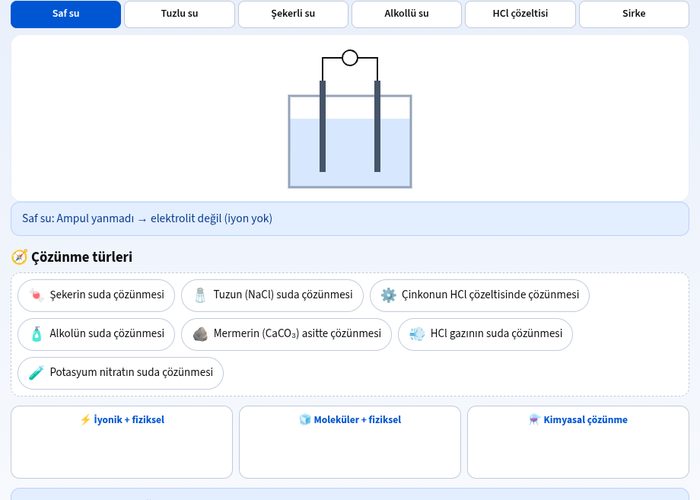
You can examine examples such as the dissolution of salt (NaCl) in water and the dissolution of sugar in water.
You can observe the dissolution of alcohol in water, the dissolution of zinc in HCl solution, and the dissolution of marble (CaCO₃) in acid.
You can test the processes of the dissolution of HCl gas in water and the dissolution of potassium nitrate in water.
You can examine 6 different solutions, such as pure water, salty water, sugary water, alcoholic water, and HCl solution, using a conductivity test.
You can classify dissolution types by dragging and dropping cards into the correct boxes.
Basic concepts and formulas
Dissolution is the homogeneous dispersion of substances within another substance. During ionic dissolution (for example, NaCl -> Na^+ + Cl^-), free ions are formed, so the solution conducts electric current. In the case of molecular dissolution (for example, C₁₂H₂₂O₁₁ or C₂H₅OH), the dissolved substances retain their molecular structure, and electric current is not conducted. While the identity properties of the substance do not change in physical dissolution, new substances are formed in chemical dissolution (such as the dissolution of zinc in acid).
How to use?
Go to the experiment panel and read the steps guided by the instructions.
Place the given example cards into the relevant category boxes by tapping or dragging and dropping them.
Test 6 different solutions during the conductivity test stage and observe the results.
Check and correct any missing or incorrect parts.
Return to the guide and review your correct answers and score.
Frequently asked questions
What is the difference between ionic dissolution and molecular dissolution?
In ionic dissolution, the solid substance dissolves in water by separating into positive and negative ions, allowing the solution to conduct electricity. In molecular dissolution, the substance dissolves in the form of molecules, and no electric current is conducted.
How do we know if dissolution is physical or chemical?
If only the interparticle interactions change without altering the chemical identity of the substance, it is referred to as physical dissolution; if new substances and bonds are formed, it is chemical dissolution.
In which solutions does the conductivity test yield results?
While salty water containing ions and acid solutions conduct electric current, pure water, sugary water, and alcoholic water do not show conductivity because they have a molecular structure.
 Interactive experiment