Factors affecting solubility: KNO₃, NaCl, KCl, and Ce₂(SO₄)₃ solubility–temperature curves; dissolving by heating, crystallization by cooling; variation of gas solubility with temperature and pressure (soda)
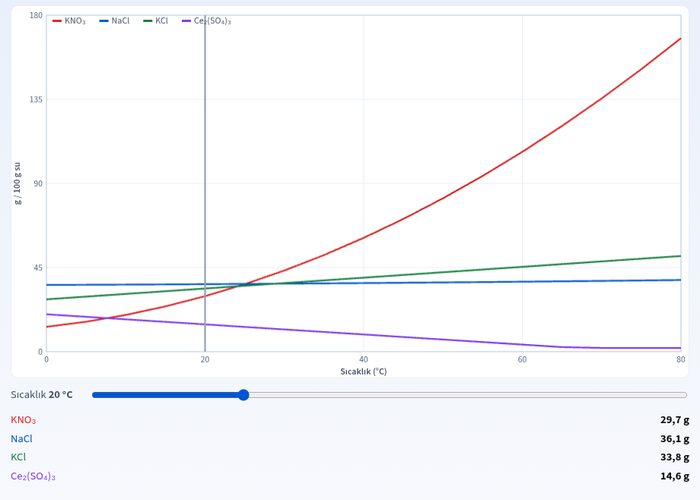
Explore critical topics in chemistry class interactively with the factors affecting solubility simulation. By examining the solubility-temperature curves of substances such as KNO₃, NaCl, KCl, and Ce₂(SO₄)₃, you will learn the effect of temperature on solid and gas solubility. You can better grasp solubility problems by observing changes in temperature and pressure on substances.
What can you do in this simulation?
You can scan the solubility curves of substances by changing the temperature between 0 °C and 80 °C.
You can compare the temperature variation graphs of KNO₃, NaCl, KCl, and Ce₂(SO₄)₃ salts.
You can see how the solubility of gases decreases with temperature and pressure by opening the bottle and applying heating.
You can experience the processes of dissolution upon heating and crystallization upon cooling.
You can test your knowledge and receive instant feedback by answering the guided questions.
Basic concepts and formulas
Solubility is the maximum amount of a substance that can dissolve in 100 grams of solvent at a specific temperature and pressure. While the solubility of solids generally increases with temperature (endothermic), the solubility of some salts (e.g., Ce₂(SO₄)₃) decreases with temperature (exothermic). The solubility of gases always decreases with increasing temperature and decreasing pressure. According to Henry's Law, the solubility of a gas is directly proportional to pressure: S = k·P.
How to use?
Open the experiment panel and set the temperature values between 0 °C and 80 °C.
Examine the solubility curves of salts and observe the changes on the graph.
Apply the steps of opening the bottle and heating for the solubility of gases.
Test your predictions with the experiment by answering the questions in the guide and check your score.
Frequently asked questions
Does the solubility of solids always increase if temperature increases?
Generally, the solubility of solids increases with temperature; however, in exceptional substances like Ce₂(SO₄)₃, solubility decreases as temperature increases.
How is the solubility of gases affected by temperature?
The solubility of gases in liquids always decreases as the temperature increases. Therefore, when beverages like soda are heated, the gas inside rapidly escapes.
How does pressure change gas solubility?
While increasing pressure increases the amount of gas molecules dissolved in the liquid, decreasing pressure reduces solubility.
 Interactive experiment