Classification of solutions: electrolyte–nonelectrolyte, concentrated–dilute, unsaturated–saturated–supersaturated; instant crystallization of a supersaturated solution with sodium acetate
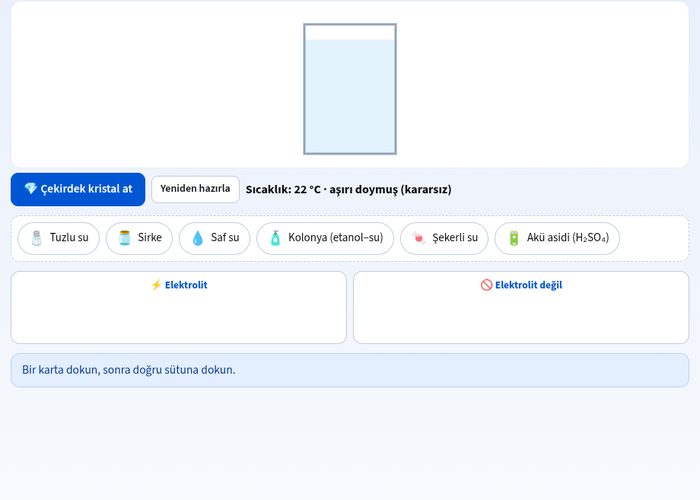
If you want to reinforce the topic of classification of solutions in chemistry class, this interactive simulation is just for you. While getting to know solutions with everyday examples such as salty water and sugary water, you will learn to distinguish between those that are electrolytes and those that are not. You will also grasp the concepts of concentrated, dilute, saturated, and supersaturated solutions through interactive card-matching activities.
What can you do in this simulation?
You can classify solutions into the correct categories based on their properties by dragging and dropping them.
You can examine different examples such as salty water and sugary water.
You can observe the instant crystallization of a supersaturated solution with sodium acetate and the release of heat.
You can progress step by step guided by instructions, answer questions, and get instant feedback.
By tracking your success score, you can retry topics where you are lacking from the beginning.
Basic concepts and formulas
Solutions are classified according to the amount of solute and their electrical conductivity. While electrolyte solutions conduct electric current because they contain ions, solutions with molecular solutes like sugary water are not electrolytes. The concepts of concentrated and dilute are relative; saturation refers to the maximum amount of a substance that can be dissolved at a given temperature. Supersaturated solutions are unstable and instantly crystallize excess substance through an external effect (such as adding a crystallization seed), releasing heat.
How to use?
Go to the experiment panel, read the instructions, and examine the first question or card group.
Select a card or item by tapping it, then place it in the box or column it belongs to.
After filling all the blanks and boxes, press the "Check" button.
See your correct answers based on the feedback received or retry missing steps.
Frequently asked questions
What is a supersaturated solution?
They are unstable solutions containing more solute than they can normally hold at a given temperature. At the slightest external trigger, the excess substance suddenly crystallizes.
What does an electrolyte solution mean?
They are solutions that dissolve by dissociating into their ions and can thus conduct electric current. While salty water is a good example of this, sugary water is not an electrolyte.
What is the difference between a concentrated and a dilute solution?
These concepts are completely relative. One containing a small amount of solute in a given volume is called dilute, while one containing a large amount of solute is called concentrated.
 Interactive experiment