Dissolution process: observe the dissolution of NaCl in water at the particle level (hydration); measure the temperature change during the dissolution of ammonium nitrate (cold pack) and calcium chloride (hot pack)
Explore the dissolution of salts in water, the hydration event, and temperature changes at the particle level with the dissolution process simulation. In this interactive chemistry experiment, you can easily learn endothermic and exothermic processes by examining the dissolution behaviors of NaCl, NH4NO3, and CaCl2 salts.
What can you do in this simulation?
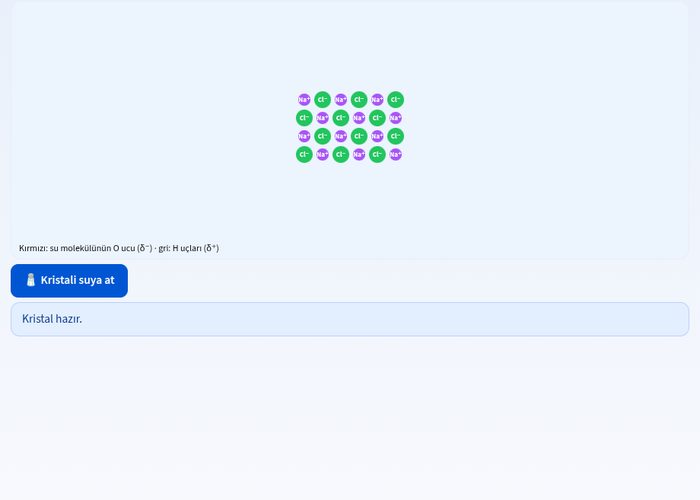
You can observe the complete dissolution of NaCl (table salt) crystal in water and the hydration performed by water molecules surrounding the ions.
You can observe temperature changes in the environment by dissolving NH4NO3 (cold pack) and CaCl2 (hot pack) salts.
You can test your knowledge about types of dissolution by placing cards into appropriate boxes or columns.
You can instantly check your correct and incorrect answers by progressing step by step with the guide.
You can restart the experiment and compare the thermal effects of different salts again.
Basic concepts and formulas
Dissolution is the dispersion of a substance within another substance at the atomic, ionic, or molecular level. Water is a polar solvent; when salts dissolve in water, they dissociate into their ions, and water molecules surround these ions to form hydration. During dissolution, the system may release heat to the outside (exothermic, e.g., CaCl2) or absorb heat from the environment (endothermic, e.g., NH4NO3).
How to use?
Open the experiment panel and select one of the salts: NaCl, NH4NO3, or CaCl2.
Place the cards or substances by tapping or dragging and dropping them into the relevant boxes.
Verify your predictions and calculations with the check button.
Gain knowledge about hydration and heat changes by reviewing the incoming explanations.
Proceed to the next step accompanied by the guide by pressing the forward button.
Frequently asked questions
What is hydration?
The process of water molecules attracting and surrounding the ions or polar molecules of the solute is called hydration.
Why does temperature change during dissolution?
Energy exchange occurs during the breaking of interionic bonds and the formation of new hydration bonds; this causes the medium to heat up or cool down.
What is the difference between endothermic and exothermic dissolution?
In endothermic dissolution, heat is absorbed from the environment and the temperature drops, whereas in exothermic dissolution, heat is released into the environment and the temperature rises.
 Interactive experiment