Thin lenses: move the object in converging (convex) and diverging (concave) lenses; find the image using special rays, 1/f = 1/d₀ + 1/dᵢ and magnification; magnifying glass, camera, and correction of vision defects
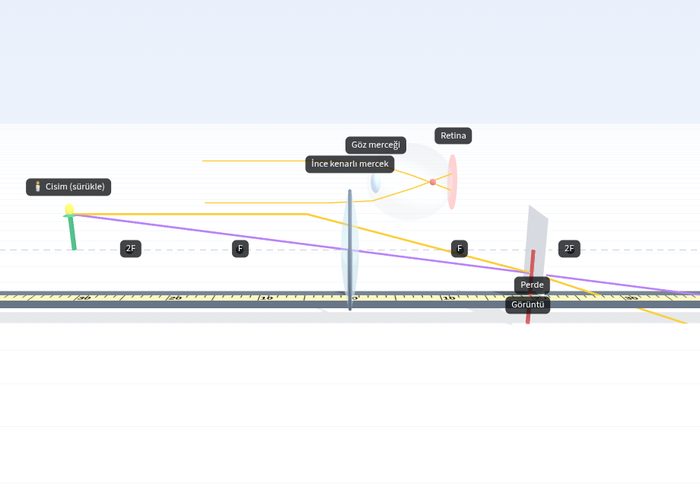
Explore the behavior of converging and diverging lenses interactively with the lenses simulation, one of the most important topics in the optics unit. In this experiment, you will learn how special rays follow their paths, the characteristics of real or virtual images, and how vision defects are corrected by changing the position of the object.
What can you do in this simulation?
You can observe the change in the image by moving the object over converging and diverging lenses.
You can examine how parallel rays coming from infinity converge at the focal point.
You can correct common vision defects such as myopia and hyperopia using appropriate lenses.
You can reinforce your optics knowledge by answering questions step-by-step with the help of a guide.
You can control the experiment steps as you wish using the Forward and Restart buttons.
Basic concepts and formulas
Lenses are transparent objects that form images by refracting light. Converging lenses gather light at a point, while diverging lenses spread light out. In the lens equation, focal length (f), object distance (d0), and image distance (di) are related as follows: 1/f = 1/d0 + 1/di. In addition, the magnification (m) formula, which is the ratio of image height to object height, is calculated using m = di / d0.
How to use?
Open the experiment screen and follow the guide to examine the converging or diverging lens type.
Observe the refraction paths of special rays by dragging the objects to appropriate positions.
Select myopia and hyperopia scenarios in the vision defects section to match the correct lenses.
Answer the questions, record your predictions, and check the results.
Frequently asked questions
Does a converging lens always form a real image?
No, when the object is placed between the focal point and the lens, the resulting image is virtual, upright, and magnified. At other positions, real and inverted images may form.
Which vision defect does a diverging lens correct?
Diverging lenses are used to correct myopia (nearsightedness) and focus the image onto the retina.
What do the signs in the lens formula mean?
Positive values are used for real images and focal points, while virtual images and diverging focal points are expressed with a negative sign.
 Interactive experiment