Prisms: split white light into colors by passing it through a glass prism (dispersion); measure the angle of deviation by changing the apex angle and the angle of incidence; minimum deviation and redirecting light with a total internal reflecting (45°) prism
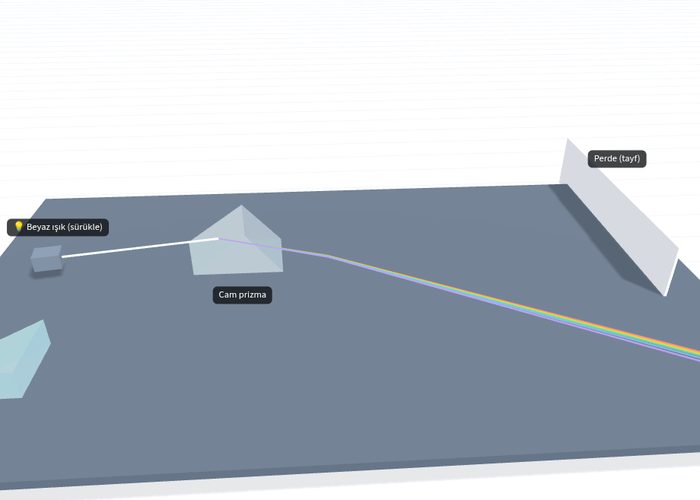
Are you ready to explore the world of optics? With the prisms simulation, you can observe the phenomenon of white light passing through a glass prism and separating into colors (dispersion), and instantly measure the angle of deviation by changing the apex angle and the angle of incidence. Don't miss this interactive experiment to reinforce the optics unit in your 11th-grade physics class.
What can you do in this simulation?
You can see how red, yellow, green, and violet colors disperse by passing white light through a glass prism.
You can follow the path of the light ray by changing the angle of incidence and the apex angle on the prism.
You can calculate and find the angle of minimum deviation and examine the amount of light deviation.
You can experience periscope and binocular systems by redirecting light with totally reflecting (45°) prisms.
You can test your optics knowledge by answering guided questions and get instant feedback.
Basic concepts and formulas
Light refracts as it passes from one medium to another. The refraction of light in prisms is explained by Snell's Law: n1·sin(θ1) = n2·sin(θ2). As white light passes through a prism, different colors refract by varying amounts because the refractive index (n) and wavelength of each color are different. Violet light is the most refracted (most deviated) color, while red light is the least refracted. The angle of deviation (δ) in a prism varies depending on the angle of incidence and the apex angle of the prism.
How to use?
Open the experiment panel and examine the white light source and the glass prism.
Observe the movement of the light ray by changing the angle of incidence or prism parameters.
Solve the guide questions regarding dispersion (separation into colors) and the angle of minimum deviation.
Try redirection applications by selecting the totally reflecting prism mode.
Check your results and repeat the steps to complete your shortcomings.
Frequently asked questions
Why does white light split into colors when passing through a prism?
A glass prism refracts lights of different wavelengths at different angles. Since violet light has the shortest wavelength, it deviates the most, whereas red light deviates the least due to its longest wavelength.
What is the angle of minimum deviation?
It is the minimum angle of deviation that occurs when the light travels parallel to the base inside the prism or is refracted symmetrically. This value is used to calculate the refractive index of the prism.
Where are totally reflecting prisms used?
45°-90°-45° isosceles right-triangular prisms are preferred in periscopes, binoculars, and cameras to deflect light by 90 or 180 degrees.
 Interactive experiment