Luminous intensity and illuminance: change the lamp's intensity, distance to the surface, and surface inclination; measure illuminance with E = I·cos θ / d²; calculate unknown luminous intensity in a photometer by finding the point where two lamps illuminate the screen equally
Explore the effect of light sources on surfaces with the luminous intensity, luminous flux, and illuminance simulation, which is one of the most fundamental topics of the optics unit. Thanks to this interactive experiment, you can observe how the amount of illuminance changes by altering the intensity of the lamp, its distance from the surface, and the angle of inclination of the surface. You can reinforce your theoretical knowledge by directly applying the formulas from your physics class and calculate unknown luminous intensity with the help of a photometer.
What can you do in this simulation?
You can examine the change in illuminance on the surface by altering the luminous intensity of the lamp.
You can adjust the distance of the light source to the surface and see the effect of distance on illuminance.
You can test the law of illuminance on inclined surfaces by tilting the surface at a specific angle.
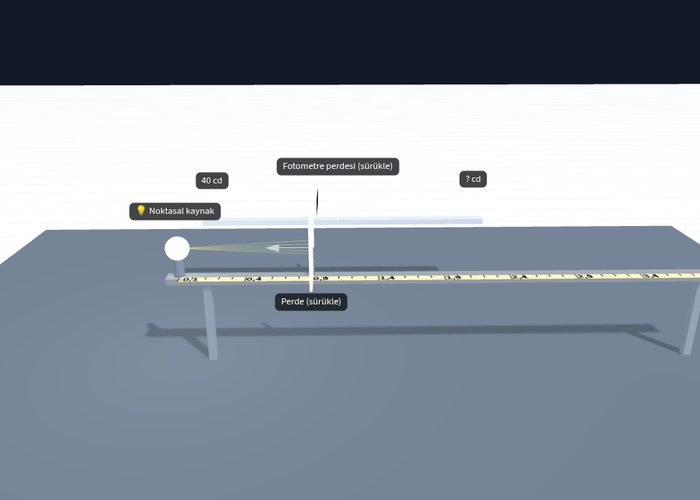
With the help of the photometer, you can find the point where two different lamps illuminate the screen equally.
You can reinforce theoretical concepts by answering questions step by step with the guidance.
Basic concepts and formulas
Luminous intensity (I) indicates the amount of light emitted by a light source per unit time, and its unit is the candela (cd). The total amount of light falling on a surface is called luminous flux (Φ) and is expressed by the relation Φ = 4·π·I. The luminous flux falling per unit area of a surface is called illuminance (E). The formula E = I / d² applies to flat surfaces. If the surface is tilted at an angle θ with the normal, the illuminance formula becomes E = (I·cos θ) / d².
How to use?
Open the experiment panel and examine the initial settings.
Change the lamp intensity and surface distance parameters to observe the values.
If necessary, adjust the surface inclination angle to test the cosine effect in the formula.
In photometer mode, use two lamps to find the equal illumination point and perform your calculation.
Answer the questions in the guide and compare your predictions with the experimental results.
Frequently asked questions
Why does illuminance decrease inversely with the square of the distance as the distance increases?
As light rays move away from their source, they spread over a spherical surface, and the area they spread over grows in proportion to the square of the distance (d²). Therefore, the amount of light falling per unit area decreases in proportion to the square of the distance.
Why does illuminance decrease when the surface is tilted?
When light rays strike the surface at a certain angle (θ) rather than perpendicularly, the effect area of the light on the surface expands, and the light intensity falling per unit area decreases due to the cos θ component.
What is the purpose of a photometer experiment?
A photometer allows you to calculate the luminous intensity of another source of unknown intensity, with the help of a light source of known intensity, using the distance ratios at the point where the screen is equally illuminated on both sides.
 Interactive experiment